

GolfTechIQ is reader-supported. When you buy through links on this page, we may earn a commission at no extra cost to you. As an Amazon Associate, we earn from qualifying purchases.
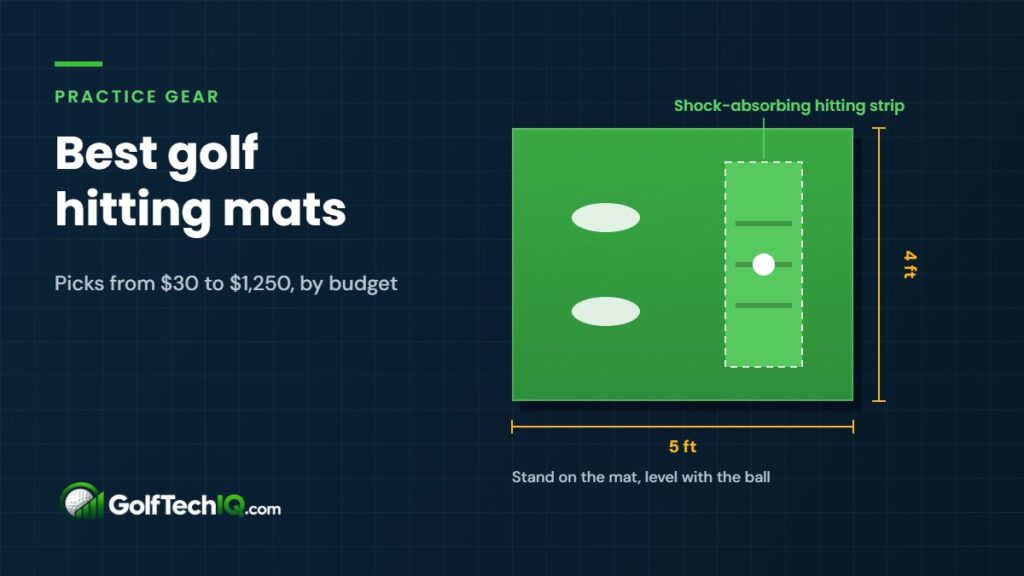
Short answer: the best golf hitting mat for most home setups is at least 4 × 5 feet (big enough to stand on so the ball isn’t above your feet), takes a real tee, and has a shock-absorbing hitting area that’s easy on your wrists and elbows. The Country Club Elite (about $319) is the value pick. For a golf simulator, step up to a mat with a replaceable hitting strip like Carl’s HotShot or SIGPRO Softy. Small $30–$60 mats are fine for chipping but too small and hard for full swings.
We picked these by the numbers: size, construction, tee options, durability claims and price. Prices are typical U.S. retail as of October 2026 and change often.
Best golf hitting mats at a glance
| Best for | Hitting mat | Size | Approx. price |
|---|---|---|---|
| Budget and backyard chipping | Rukket Tri-Turf or Callaway Launch Zone | Small | $30–$60 |
| Best value full-size mat | Country Club Elite Real Feel | 4 × 4 ft and up | About $319 |
| Easier on joints for less | Dura-Pro 4′ × 5′ | 4 × 5 ft | About $212 |
| Golf simulators | Carl’s HotShot | 4 × 5 to 6 × 10 ft | $600–$1,512 |
| Real tees and a soft strike | SIGPRO Softy 4′ × 7′ | 4 × 7 ft | $800–$1,000 |
| Premium, most realistic | Fiberbuilt Studio or TrueStrike | 4 × 7 ft | $930–$1,250 |
1. Budget mats: Rukket Tri-Turf and Callaway Launch Zone
At about $30–$60, these small mats are a cheap way to protect the lawn or practice chips in the backyard. The catch: they’re too small to stand on, so the ball sits above your feet unless you add a stance mat, and the firm surface lets the club bounce into the ball, hiding fat shots. Fine for wedges; not what you want for hundreds of full swings.
Check Rukket mat price on Amazon
2. Country Club Elite Real Feel: best value
The most popular step up from budget mats, at about $319. The turf is far more realistic, it takes a real wooden tee, and it needs no assembly. Choose 4 × 4 feet or larger so you can hit driver. The trade-offs: it’s firm, so you’ll feel more impact in your wrists and elbows than on a softer mat, and the smooth foam base can slide on a hard floor unless you put a rug gripper or tape under it.
Check Country Club Elite price on Amazon
3. Dura-Pro 4′ × 5′: easier on your joints for less
About $212 for a 4 × 5 foot mat with a thicker rubber backing that absorbs more shock than budget mats. It’s big enough to stand on and hit every club. A good choice if joint comfort matters but a $600+ simulator mat doesn’t fit the budget.
Check Dura-Pro mat price on Amazon
4. Carl’s HotShot: best for golf simulators
A popular choice for home simulator builds. HotShot systems come in 4 × 5, 5 × 8, 4 × 9 and 6 × 10 foot sizes, and you pick the hitting strip: standard, foam divot or gel divot. When the strip wears out, you replace just the strip, not the whole mat. Prices run about $600 for a 4 × 5 with a standard strip to about $1,500 for the largest gel-strip system. Sold through Carl’s Place and simulator retailers.
5. SIGPRO Softy 4′ × 7′: real tees and a soft strike
One-inch turf over soft foam, with a replaceable hitting strip that has three compression slots to absorb the club at impact. Unlike most premium mats, it takes a real tee at an adjustable height, and at about 21 pounds it’s light enough to move. Listed at about $1,000, often on sale for about $800.
Check SIGPRO Softy price on Amazon
6. Fiberbuilt and TrueStrike: premium picks
- Fiberbuilt 4′ × 7′ Studio mat (about $1,249): Fiberbuilt’s grass-style hitting panel is backed by a 300,000-shot guarantee and sits on a shock-absorbing rubber base. It’s heavy (141 pounds assembled) and uses rubber tees rather than real ones.
- TrueStrike Single (about $930–$1,130): a gel hitting section that gives slightly at impact, like turf, used by college teams and driving ranges. The modular sections are replaceable, but it weighs over 100 pounds and real tees only go in the turf sections, not the gel.
Both are sold through simulator retailers rather than Amazon.
How to choose a golf hitting mat
- Size: 4 × 5 feet is a good minimum so you can stand on the mat and hit driver. For a simulator, 4 × 7 feet or larger leaves room for a launch monitor beside the ball.
- Impact absorption: the most important factor for your joints. Look for a gel or foam hitting strip, compression slots or thick rubber backing. Hard, thin mats transmit shock to your wrists and elbows.
- Fat-shot feedback: a good mat makes a heavy shot feel heavy. Firm, cheap mats let the club bounce into the ball, which hides mistakes.
- Tee options: some mats take real wooden tees; others use rubber tees or tee receivers. If you want to tee it low with driver, check this.
- Replaceable strip: the hitting area wears out first. A replaceable strip lowers long-term cost.
- Indoor or outdoor: check that the mat is rated for where you’ll use it, and use a non-slip base on concrete.
- Weight: heavy mats stay put and last, but they’re hard to move if the space has other uses.
Practice tips for hitting off a mat
- Put a towel a few inches behind the ball. If you hit it, you’re catching the ground first, even if the mat makes the shot look fine.
- Check where you strike the clubface with face tape or foot spray.
- Warm up with wedges before full swings, and take breaks; mats are harder than turf.
Pair a mat with a golf practice net for a complete practice setup, or see what a full build costs in our golf simulator cost guide and DIY golf simulator guide. For the short game, see the best putting mats.
FAQ
What size golf hitting mat do I need?
At least 4 × 5 feet, so you can stand on the mat with the ball level with your feet and hit every club. Go 4 × 7 feet or larger for a golf simulator, where a launch monitor often sits beside the ball.
Are golf hitting mats bad for your joints?
Hard, thin mats can be, because the club can’t dig in and the shock goes into your wrists and elbows. Mats with a gel, foam or compression-slot hitting strip or thick rubber backing absorb more of that impact.
Can you use a real tee on a golf mat?
On some. The Country Club Elite and SIGPRO Softy take real wooden tees. Others, like Fiberbuilt, use rubber tees or tee holders, and TrueStrike takes real tees only in its turf sections.
How long does a golf hitting mat last?
It depends on how much you hit. Budget mats can wear through in a season of heavy use. Premium mats are rated for far more: Fiberbuilt guarantees its hitting panel for 300,000 shots, and mats with replaceable strips let you swap only the worn part.
Sources: Carl’s Place, best golf hitting mats; Practical Golf, complete guide to golf mats; Shop Indoor Golf, best golf mats; PlayBetter, Carl’s HotShot systems; Golf Training Aids, SIGPRO Softy 4′ × 7′; Shop Indoor Golf, Fiberbuilt 4′ × 7′ Studio; Shop Indoor Golf, TrueStrike Single.
Keep reading
 Backyard Putting Green: Cost, Turf and How to Build One
What a backyard putting green costs installed or DIY, how to choose putting green turf, and how to build one…
 Best Putting Mats for Indoor Practice (2026 Picks)
The best putting mats for indoor practice, picked by size, speed, features and price, from a $50 ball-return mat to…
 Golf Practice Net: How to Choose the Best Net for Your Backyard or Garage
Most golfers need a 10 x 7 foot practice net. Here is how to choose between portable pop-up nets, ball-return…