

GolfTechIQ is reader-supported. As an Amazon Associate, we earn from qualifying purchases.
Short answer: a golf ball compression chart ranks balls from soft (under 60) to firm (over 95). Value balls like the Wilson Duo Soft (37) and Callaway Supersoft (about 44) are the softest; tour balls like the Srixon Z-Star XV (102) and Titleist Pro V1x (about 101) are the firmest. Golf ball compression matters less than the marketing says: robot tests show soft balls are not longer, even at slow speeds. To find the best golf ball for you, start from your swing speed, then pick by spin and price. The finder below does that in a few seconds.
Enter your driver swing speed, or your typical carry if you do not know your speed, and pick what matters most. The finder suggests a compression range and three balls from the chart below.
Your golf ball match
| Ball | Compression | Cover | Price |
|---|
The finder uses only balls with a published or lab-measured compression number. If you enter carry instead of speed, it estimates club speed from Today’s Golfer robot data (about 162 yards of carry at 78 mph and 275 yards at 114 mph). A robot strikes it perfectly, so if you often miss the center, your real speed is probably a bit higher than the estimate. For a better estimate, use our swing speed distance calculator.
Golf ball compression chart (2026)
Sorted from softest to firmest. The source column matters. Srixon and Wilson publish compression numbers. Titleist, Callaway, Bridgestone and TaylorMade mostly do not, so for those balls we list MyGolfSpy’s Ball Lab readings, which use the same gauge for every ball. Where neither exists, we say “not published” instead of guessing.
| Ball | Compression | Source | Cover | Price tier |
|---|---|---|---|---|
| Wilson Duo Soft (2025) | 37 | Wilson | Ionomer | Budget |
| Callaway Supersoft (2026) | 44 | MyGolfSpy measured | Ionomer | Budget |
| Bridgestone e6 Soft (2025) | Not published | 45 on Today’s Golfer’s gauge | Ionomer | Budget |
| TaylorMade SpeedSoft | 50 | MyGolfSpy measured | Ionomer | Budget |
| Srixon Soft Feel (2025) | 58 | Srixon | Ionomer | Budget |
| Callaway Warbird Distance+ (2025) | Not published | Callaway: “highly compressible” core | Ionomer | Budget |
| Titleist TruFeel | 70 | MyGolfSpy measured | Ionomer | Budget |
| Srixon Q-Star Tour (2026) | 74 | Srixon | Urethane | Mid |
| TaylorMade Tour Response (2026) | 74 | MyGolfSpy measured | Urethane | Mid |
| Callaway ERC Soft (2025) | Not published | – | Non-urethane | Mid |
| Wilson Triad (2025) | 80 | Wilson | Urethane | Mid |
| Bridgestone Tour B RXS (2026) | Not published | Bridgestone: for swing speeds under 105 mph | Urethane | Premium |
| Callaway Chrome Soft (2026) | Not published | Callaway: softest of its 2026 Chrome line | Urethane | Premium |
| Titleist Tour Soft | 88 | MyGolfSpy measured | Ionomer | Mid |
| Srixon Z-Star (2025) | 88 | Srixon | Urethane | Premium |
| Titleist Velocity | 90 | MyGolfSpy measured | Ionomer | Budget |
| Wilson Staff Model (2026) | 90 | Wilson | Urethane | Premium |
| Callaway Chrome Tour (2026) | 91 | MyGolfSpy measured | Urethane | Premium |
| TaylorMade TP5 (2026) | 92 | MyGolfSpy measured | Urethane | Premium |
| Titleist Pro V1 (2025) | 92 | MyGolfSpy measured | Urethane | Premium |
| Titleist AVX | Not published | – | Urethane | Premium |
| Srixon Z-Star Diamond (2025) | 100 | Srixon | Urethane | Premium |
| Titleist Pro V1x (2025) | 101 | MyGolfSpy measured | Urethane | Premium |
| Srixon Z-Star XV (2025) | 102 | Srixon | Urethane | Premium |
| Bridgestone Tour B X | Not published | Bridgestone: for swing speeds over 105 mph | Urethane | Premium |
Price tiers: Budget is about $30 a dozen or less, Mid is about $35 to $45, and Premium is about $50 to $58. Examples: Srixon Soft Feel $24.99, Titleist TruFeel $24.99, Srixon Q-Star Tour $39.99, Srixon Z-Star $49.99, Titleist Pro V1 $57.99. Prices are typical U.S. retail as of November 2026 from brand sites and major golf retailers. They change often, especially around Black Friday.
Two cautions. First, compression gauges do not agree. Today’s Golfer’s gauge read the 2026 Callaway Chrome Tour at 113; MyGolfSpy’s read it at 91. Compare numbers within one column, not across sources. Second, balls change every one to two years, so check the model year on the box.
What golf ball compression means
Compression is how much a ball squashes under a set load. A low number means a softer ball that deforms more; a high number means a firmer one. Most modern balls fall between about 35 and 105. MyGolfSpy notes there is no single industry-standard gauge, so one brand’s 90 can be another’s 87.
Cover material is a separate thing. Ionomer (Surlyn) covers are tough and spin less, which helps keep drives straighter. Urethane covers are softer and grab wedges, so the ball stops faster around the green. A ball can be low compression with a urethane cover (Srixon Q-Star Tour) or firm with an ionomer cover (Titleist Velocity).
Does golf ball compression matter? What the data says
Less than you have been told. The old rule is “slow swing, soft ball,” on the idea that a slow swing cannot compress a firm ball. Recent robot tests do not back that up:
- Soft balls were shorter off the driver at every speed. Today’s Golfer hit 62 balls with a swing robot at 78, 93 and 114 mph. The softest balls carried about 8 yards less than firmer ones at 78 mph, 11 yards less at 93 mph and up to 15 yards less at 114 mph.
- Ball speed barely changed with compression. In MyGolfSpy’s slower-swing testing, driver ball speed was about 123 mph for balls ranging from 50 to 102 compression. Distance tracked spin, not compression.
- Firm tour balls work at slow speeds. At 78 mph, Today’s Golfer found the softer Pro V1 carried just 1.4 yards farther than the firmer Pro V1x. At 93 and 114 mph the two were virtually the same.
- Soft balls do have strengths. In the same Today’s Golfer test, the Callaway Supersoft and TaylorMade SpeedSoft were second and third for 7-iron carry. But no ball rated 80 or below finished in the top half for wedge spin.
The takeaway: compression is a useful shorthand for feel and for sorting balls, but it is not a distance dial. Spin, launch and the cover decide more of what you see on the course.
Golf ball compression by swing speed
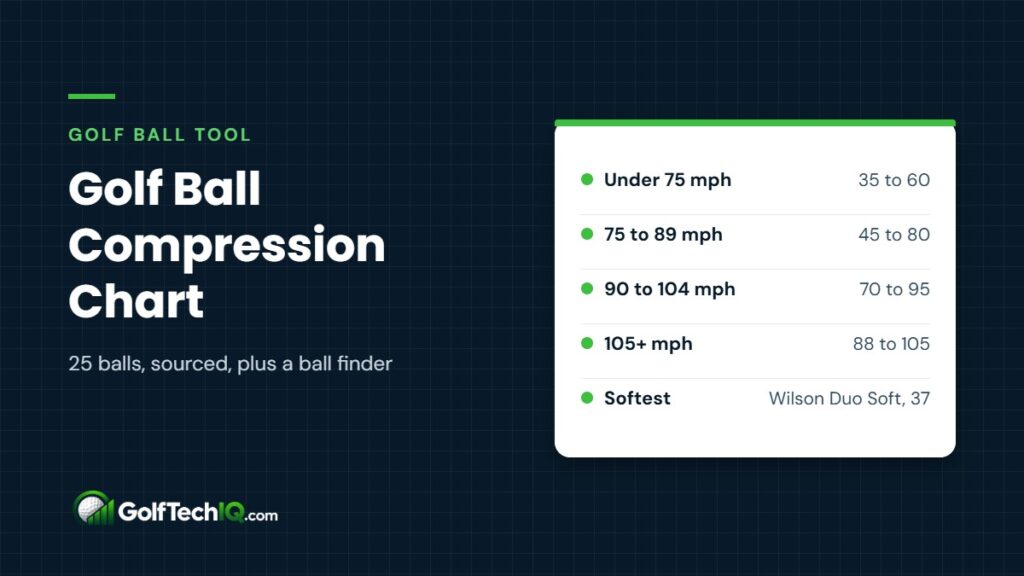
These are the ranges the finder uses. Treat them as a starting point, not a rule. If you do not know your speed, our golf club distance chart shows typical driver distances by handicap.
| Driver swing speed | Suggested compression | Balls to try |
|---|---|---|
| Under 75 mph | 35 to 60 | Wilson Duo Soft, Callaway Supersoft, Srixon Soft Feel |
| 75 to 89 mph | 45 to 80 | Srixon Soft Feel, Titleist TruFeel, Srixon Q-Star Tour |
| 90 to 104 mph | 70 to 95 | Srixon Q-Star Tour, Wilson Triad, Srixon Z-Star, Titleist Pro V1 |
| 105 mph and up | 88 to 105 | Titleist Pro V1 or Pro V1x, Srixon Z-Star XV, TaylorMade TP5 |
Bridgestone skips numbers and fits by speed instead: its Tour B RXS and RX are for swing speeds under 105 mph, and the Tour B X and XS are for faster swings.
What is the best golf ball for me?
- Know your speed. A launch monitor or a fitting gives you club speed in one session. Without one, use your carry distance in the finder above.
- Decide how many balls you lose. If you lose three or more a round, a $25 dozen (about $2 a ball) beats a $58 dozen (about $4.83 a ball). See our best golf balls for beginners and best golf balls for high handicappers.
- Decide if you need greenside spin. If you chip and pitch onto greens often and want the ball to check, pick a urethane cover. Srixon Q-Star Tour and TaylorMade Tour Response are the cheapest urethane balls on the chart.
- Test a sleeve, not a dozen. Hit chips, a few irons and drives with two or three balls from your range, then buy a dozen of the one you like.
Slow swing or a senior golfer? See our best golf balls for seniors. For a full ranked list of every type of ball, see our best golf balls guide.
Popular picks by swing speed
Slower swings: Callaway Supersoft
About $27 a dozen and about 44 compression on MyGolfSpy’s gauge. It is soft, cheap enough to lose, and was second for 7-iron carry in Today’s Golfer’s robot test. It spins little around the greens.
Moderate swings: Srixon Q-Star Tour
A urethane-cover ball at $39.99 with a Srixon-rated 74 compression. It is the cheapest way on this chart to get real greenside spin with a mid-compression feel.
Faster swings: Titleist Pro V1
About 92 on MyGolfSpy’s gauge and $57.99 a dozen. It is the ball many regular players already use, and the robot data says slower swingers can play it too if they want the spin.
Compression advice is often given by handicap. If you do not have an official one yet, our free golf handicap calculator estimates your Handicap Index from your recent scores.
Related: Vice golf balls: compression and price for every model
FAQ
What compression golf ball should I use?
Start with your driver swing speed: about 35 to 60 under 75 mph, 45 to 80 from 75 to 89 mph, 70 to 95 from 90 to 104 mph, and 88 or higher above that. Then choose by cover and price. Robot tests show compression changes distance less than most golfers expect.
Is a lower compression golf ball better for slow swing speeds?
Not for distance. In Today’s Golfer’s robot test, the softest balls carried about 8 yards less than firmer balls at 78 mph. Low compression mostly changes feel. Many slower swingers still like it, and that is a fine reason to play one.
What is the compression of a Pro V1?
Titleist does not publish compression. MyGolfSpy’s Ball Lab measured the 2025 Pro V1 at about 92 and the 2025 Pro V1x at about 101. Other gauges read higher.
Why do compression numbers differ between charts?
There is no single industry gauge, and some brands quote core compression rather than the whole ball. Today’s Golfer’s gauge read the 2026 Callaway Chrome Tour at 113 while MyGolfSpy’s read 91. Compare balls within one source.
What is the softest golf ball?
On this chart, the Wilson Duo Soft at 37 (Wilson’s figure), then the Callaway Supersoft at about 44 (MyGolfSpy). Both are ionomer-cover balls that cost about $30 or less a dozen.
Sources: Srixon 2025 Z-STAR series announcement (compression 88, 100, 102); Srixon Q-STAR TOUR launch release; Golf Monthly, 2026 Q-Star Tour review (74 compression); Golf Galaxy, Srixon 2025 Soft Feel specs (58 compression); Golf Business News, Wilson 2025 Triad and Duo Soft (80 and 37 compression); Golf Digest, Wilson 2025 releases; Golf Digest, Wilson Staff Model 2026; MyGolfSpy Ball Lab, Titleist Pro V1 (2025); MyGolfSpy Ball Lab, Titleist Pro V1x (2025); MyGolfSpy, Titleist Velocity, TruFeel and Tour Soft; MyGolfSpy Ball Lab, Callaway Supersoft (2026); MyGolfSpy Ball Lab, Callaway Chrome Tour (2026); MyGolfSpy Ball Lab, TaylorMade TP5 (2026); MyGolfSpy, why compression alone is the wrong way for slower swingers to choose a ball; MyGolfSpy golf ball compression guide; Today’s Golfer, robot test of 62 balls: stop buying soft golf balls; Today’s Golfer, Pro V1 vs Pro V1x robot test; BallCaddie compression chart (Bridgestone e6 gauge figure); Golf Galaxy, Bridgestone 2026 Tour B RXS; Golf Monthly, Callaway 2026 Chrome lineup; Callaway, Warbird Distance+ (2025); Golf Discount, Titleist 2026 ball prices; Golf Discount, Callaway Supersoft prices; GOLF.com, Titleist 2026 Velocity and Tour Soft.
GolfTechIQ is reader-supported. When you buy through links on this page, we may earn a commission at no extra cost to you. As an Amazon Associate, we earn from qualifying purchases.
Keep reading
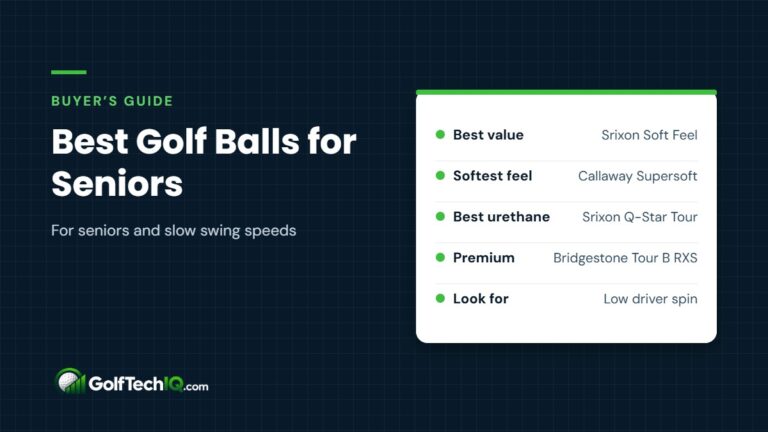 Best Golf Balls for Seniors and Slow Swing Speeds (2026)
Low-compression and urethane golf balls for seniors and slower swing speeds, picked by spin, feel and price, with what the…
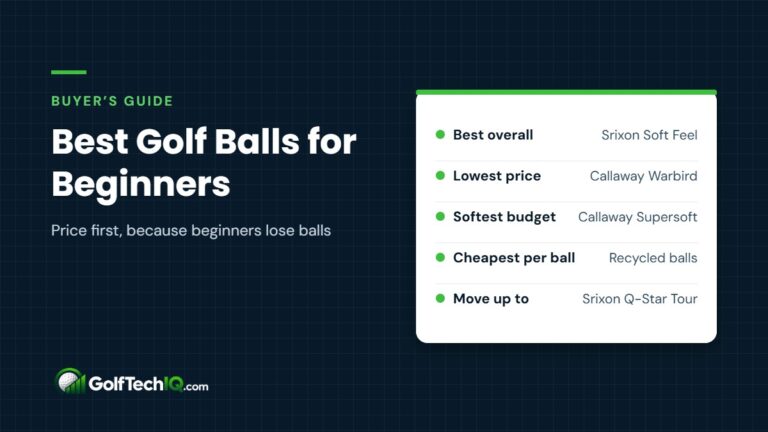 Best Golf Balls for Beginners (2026): Cheap Balls That Make Sense
Cheap, low-spin golf balls for new golfers who lose a few a round, plus recycled options and when to move…
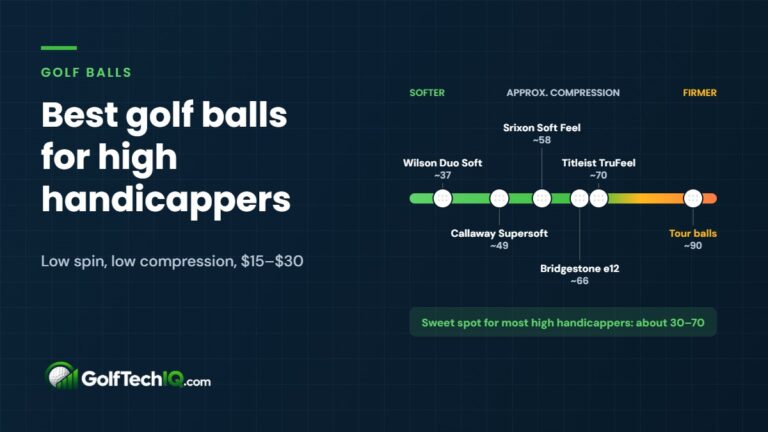 Best Golf Balls for High Handicappers (2026)
The best golf balls for high handicappers: low-spin, low-compression balls from $15 to $30 a dozen, picked using robot test…