

GolfTechIQ is reader-supported. When you buy through links on this page, we may earn a commission at no extra cost to you. As an Amazon Associate, we earn from qualifying purchases.
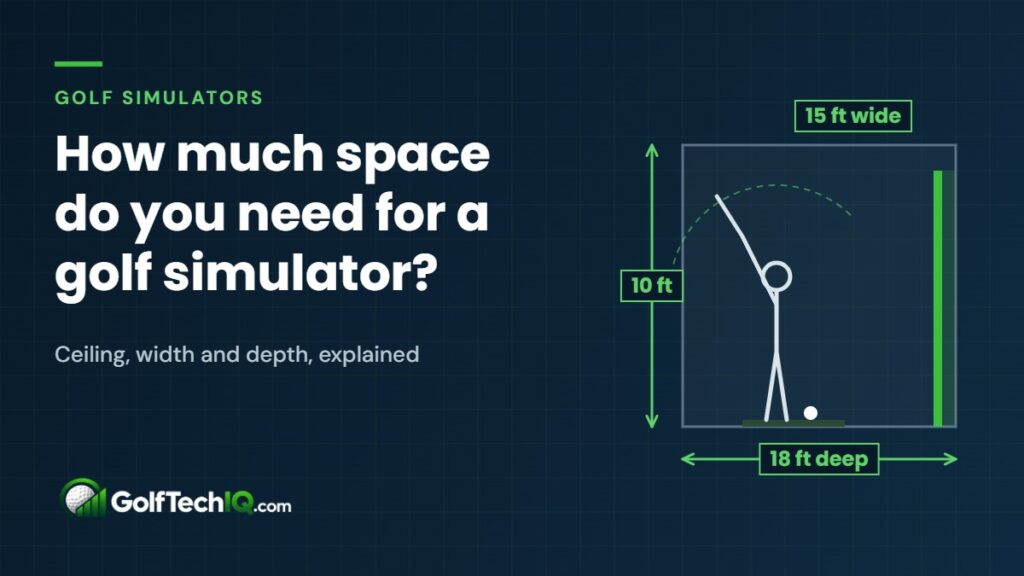
Short answer: most golfers need a room about 10 feet tall, 15 feet wide and 18 feet deep to swing a driver comfortably in a home golf simulator. You can get by with less, as low as a 9-foot ceiling, 12 feet of width and 15 feet of depth, if you pick the right launch monitor and enclosure. The launch monitor matters more than most people expect, because radar units sit behind you and eat up depth.
Below we break down each dimension, what the major launch monitor makers recommend, and how to check your own room. If you already have a tape measure out, skip straight to our golf simulator room size calculator.
The quick numbers
| Dimension | Tight but workable | Comfortable | Ideal |
|---|---|---|---|
| Ceiling height | 9 ft | 10 ft | 10–11 ft+ |
| Room width | 12 ft | 14 ft | 15 ft+ |
| Room depth (camera unit) | 15–16 ft | 17 ft | 18–20 ft |
| Room depth (radar unit) | 18 ft | 20 ft | 21 ft+ |
Ceiling height: the measurement that rules out most rooms
Ceiling height is the one dimension you can’t fix by moving furniture, so measure it first. Trackman calls 10 feet the practical minimum to swing comfortably, and SkyTrak says 10 feet “typically offers ample clearance” while noting many golfers find 9 feet is enough.
Whether 9 feet works for you depends on three things:
- Your height. Taller golfers have a higher swing arc. If you’re over about 6 feet, plan on 10 feet.
- Your swing. Upright swings and big follow-throughs need more room than flatter swings.
- Where you stand. Ceilings often have beams, lights or garage door tracks. Measure the height directly above where you’ll actually swing.
The broomstick test: before buying anything, stand where your hitting mat would go and make slow practice swings with your driver (or a broomstick of the same length). If you clear the ceiling with a few inches to spare at full speed, you’re fine. If you brush it, you’ll need a higher room or you’ll be limited to irons.
Under 9 feet, full driver swings usually aren’t realistic. Trackman says 8-foot ceilings work only in rare cases with modified swings. That said, an 8-foot room can still be a great short-game and iron practice space.
Room width: 12 to 15 feet
Width has to cover your swing plus the screen or net. Impact screens and nets usually run 8 to 13 feet wide, and SkyTrak suggests about 12 feet for a comfortable feel. Trackman uses 15 feet as its benchmark.
The bigger question is where you stand. Most setups put the hitting mat off center so a right-handed golfer has room for the backswing. If a left-handed golfer will use the same room, you either need a second hitting spot or a centered mat with enough room on both sides. SkyTrak recommends adding 1 to 2 feet of width if both right- and left-handed players will use the simulator.
Room depth: where your launch monitor makes the biggest difference
Depth is made up of three pieces:
- Screen or net clearance: the screen needs space behind it so it doesn’t slam into the wall, usually 6 to 12 inches for an enclosure and more for a freestanding net.
- Ball to screen: most guides land on about 10 feet. Shorter distances can work but leave less room for the ball to fly and for some launch monitors to read it.
- Behind the ball: the room you need to stand and swing, plus, for radar units, the space where the launch monitor sits.
That third piece is where the launch monitor type changes everything.
Radar units sit behind you
Radar launch monitors track the ball from behind, so they need space back there. Garmin’s manual says to place the Approach R10 about 6–8 feet behind the ball. Rapsodo’s MLM2PRO guidance puts the unit roughly 6.5–8.5 feet behind the ball with at least 8 feet of ball flight in front. Add 8–10 feet in front of the ball and you’re at roughly 18–21 feet of total depth.
Camera units sit beside the ball
Photometric (camera-based) units like the SkyTrak ST MAX sit next to the ball instead of behind it, which saves several feet. SkyTrak’s own room plans list a 16-foot minimum depth with 17–20 feet as ideal for its 10- and 12-foot studios. If your room is short on depth, a side-of-ball unit is usually the answer.
Ceiling-mounted units stay out of the way
Overhead systems such as the Trackman iO mount on the ceiling above the hitting area, so nothing sits on the floor. Trackman’s guidance for iO is a 10-foot ceiling, 15-foot width and 10+ feet from ball to screen. These are the most premium option and the cleanest-looking room, but they need the ceiling height to mount properly.
Space by launch monitor
| Launch monitor | Type | Unit position | Typical total depth |
|---|---|---|---|
| Garmin Approach R10 | Radar | 6–8 ft behind ball | 18–21 ft |
| Rapsodo MLM2PRO | Radar + camera | 6.5–8.5 ft behind ball | 17–21 ft |
| SkyTrak ST MAX | Camera (+ radar) | Beside the ball | 16–20 ft |
| Trackman iO | Ceiling-mounted | Overhead | About 18 ft |
Common rooms and whether they work
- Two-car garage: usually 20 × 20 feet or more, often the best spot in the house for depth and width. The catch is ceiling height and the garage door track. Measure under the door when it’s open.
- Basement: often wide and deep enough, but ceilings can be 7.5–8 feet with ducts and beams. Many basements work only after checking the exact spot you’ll swing.
- Spare bedroom: a typical 12 × 12 room is tight. Trackman notes it may allow short irons but will feel cramped with a driver.
- Bonus room or loft: great when ceilings are 10 feet or more; watch for sloped ceilings above the hitting area.
Check your room in 60 seconds
Our free golf simulator room size calculator takes your ceiling height, width and depth, plus your handedness and launch monitor type, and tells you whether your space fits, where it’s tight, and which launch monitor styles will work.
Next steps: once you know your room works, see our full guide to choosing a golf simulator for home, check the ceiling height you need in more detail, and price out your setup with our golf simulator cost guide. Building in a garage? Read golf simulator in a garage.
FAQ
Can I use a golf simulator with an 8-foot ceiling?
For full driver swings, usually not. For irons, wedges and putting, often yes, especially if you’re shorter or have a flatter swing. Do the broomstick test before buying.
What’s the smallest room for a golf simulator?
SkyTrak’s smallest studio lists a minimum room of 8.5 feet wide, 15 feet deep and 8 feet tall, but that’s for a compact setup with real swing limits. For a driver, plan on at least 9 feet of ceiling, 12 feet of width and 15–16 feet of depth with a side-of-ball launch monitor.
How far should I stand from the screen?
About 10 feet from the ball to the screen is the common target. Some setups go closer, but you’ll want enough distance for the ball to slow down and for your launch monitor to read the flight.
Do left-handed golfers need a bigger room?
Not bigger, just set up differently. The problem comes when left- and right-handed golfers share one room. Then you need extra width, about 1–2 feet more, or a centered hitting position.
Sources: Trackman, How much room for a golf simulator; SkyTrak, Plan your space; Garmin Approach R10 owner’s manual; PlayBetter, Rapsodo MLM2PRO space requirements.
Keep reading
 Ceiling Height for a Golf Simulator: How High Is High Enough?
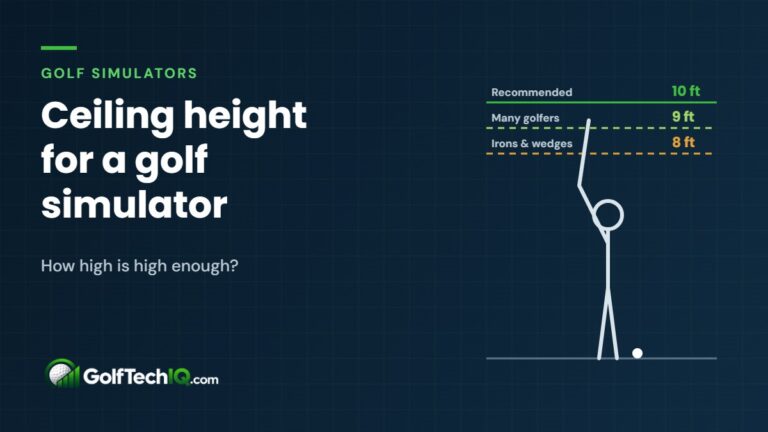
Plan on a 10-foot ceiling to swing a driver freely in a golf simulator; many golfers can make 9 feet…
 Golf Simulator for Home: How to Choose the Right Setup (2026 Guide)
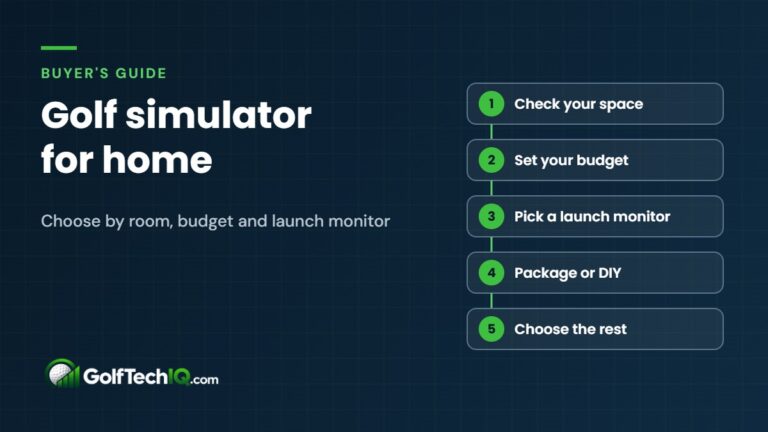
Choosing a golf simulator for home comes down to your room, your budget and a launch monitor that fits both.…
 How Much Does a Golf Simulator Cost? Real Budgets from $1,000 to $15,000+
A home golf simulator costs about $1,000 for a practice setup, $5,000 to $7,000 for a full simulator and $15,000+…