

GolfTechIQ is reader-supported. When you buy through links on this page, we may earn a commission at no extra cost to you. As an Amazon Associate, we earn from qualifying purchases.
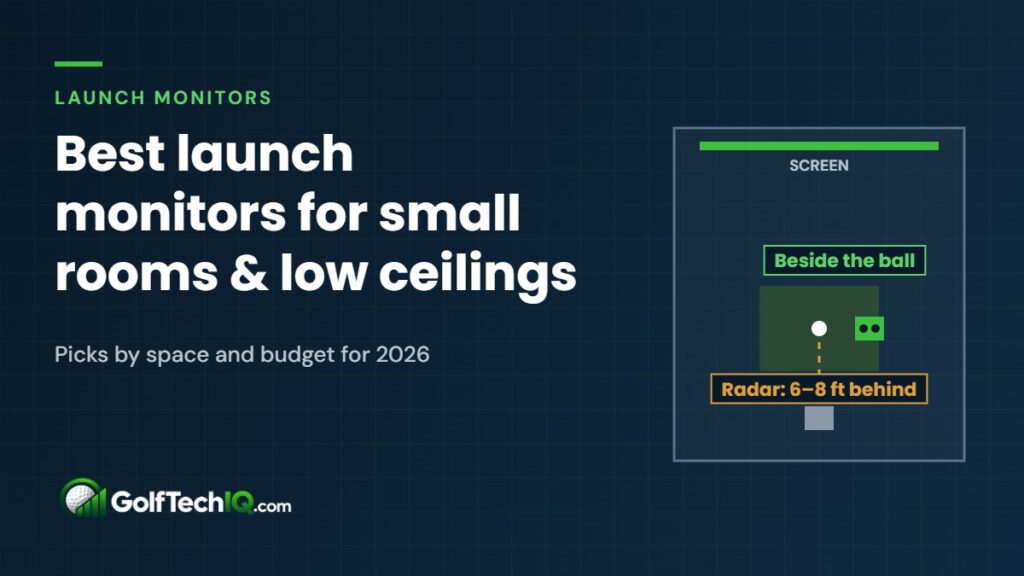
Short answer: if your room is short on depth, buy a launch monitor that sits beside the ball, not behind it. Camera-based units like the SkyTrak ST MAX, Square Golf and Garmin Approach R50 can work in rooms around 15–16 feet deep, while most radar units need 6–8 feet of space behind the ball on top of everything else. If your ceiling is the problem, no launch monitor fixes that. You need about 9 feet to swing a driver.
We picked these by the numbers: where each unit sits, how much room it needs, and what it costs. Prices are typical U.S. retail as of October 2026 and change often, so check before you buy.
Our picks at a glance
| Pick | Launch monitor | Sits | Approx. price |
|---|---|---|---|
| Best overall for small rooms | SkyTrak ST MAX | Beside the ball | $1,695 |
| Best budget | Square Golf | Beside the ball | From $700 |
| Best budget indoor + outdoor | Square Golf Omni | Beside the ball | $1,600 |
| Best all-in-one | Garmin Approach R50 | Beside the ball | $4,999 |
| Best for shared lefty/righty rooms | Uneekor EYE XR or EYE XO | Ceiling | From $5,999 |
| Best radar option if you have ~15 ft | Rapsodo MLM2PRO | Behind the ball | From $550 |
Why “beside the ball” matters in a small room
Every home simulator needs three things front to back: room to swing, roughly 10 feet from ball to screen, and a little clearance behind the screen. Radar launch monitors add a fourth: the unit itself sits 6–8 feet behind the ball so it can track the flight. In a deep garage that’s no problem. In a spare bedroom or basement, those extra feet are often what you don’t have.
Camera-based (photometric) units sit on the floor next to the ball and read it at impact, so they need no space behind you at all. Ceiling-mounted units take nothing from the floor either, but they need enough ceiling height to mount. Not sure what your room can handle? Run it through our golf simulator room size calculator first.
1. SkyTrak ST MAX: best overall for small rooms
The ST MAX is SkyTrak’s current model and replaces the SkyTrak+, which is now out of stock at most retailers. It sits beside the ball and combines photometric cameras with Doppler radar, the same tracking approach as the SkyTrak+. Retailer setup guides put a comfortable room at about 9 feet of ceiling and 10 feet of width.
- Why it fits small rooms: no space needed behind the golfer.
- Good to know: it’s side-mounted, so switching between right- and left-handed golfers means moving the unit to the other side of the ball.
- Approx. price: $1,695.
2. Square Golf: best budget pick
Square Golf is one of the least expensive ways to get a side-of-ball camera unit. It’s built for indoor use, which is exactly where space is tight. If you’re working with a smaller budget and a smaller room, it’s the first one to look at.
- Why it fits small rooms: sits beside the ball, compact footprint.
- Good to know: the original Square is indoor-only.
- Approx. price: from $700.
3. Square Golf Omni: best budget pick for indoor and outdoor
The Omni uses a four-camera photometric system that reads the ball from the side at impact, and unlike the original Square it works outdoors too. Retailer guidelines suggest about 10 feet of width and a 9-foot ceiling, with no subscription required.
- Why it fits small rooms: side-of-ball, no space behind you.
- Good to know: worth the step up only if you’ll also take it to the range.
- Approx. price: $1,600.
4. Garmin Approach R50: best all-in-one
The R50 is a premium camera unit with three high-speed cameras and its own 10-inch touchscreen, so it can run on its own without a laptop. Garmin says it captures more than 15 ball and club metrics. Because it sits to the side of the ball rather than 6–8 feet behind like Garmin’s R10, it needs far less depth.
- Why it fits small rooms: side-of-ball, and fewer extra devices to find room for.
- Good to know: like other side units, it has to be moved for left-handed golfers.
- Approx. price: $4,999.
5. Uneekor EYE XR or EYE XO: best for lefty/righty rooms
Uneekor’s overhead units mount on the ceiling above the hitting area, so nothing sits on the floor and nothing has to be moved when a left-handed golfer steps up. That makes them the cleanest fit for families or friends who share a sim. The trade-off is ceiling height: retailer guides suggest roughly 9–10 feet so there’s room to mount the unit above your swing.
- Why it fits small rooms: nothing on the floor; no space behind you.
- Good to know: not a fix for low ceilings. If you’re under 9 feet, look at a side-of-ball unit instead.
- Approx. price: EYE XR from $5,999; EYE XO from $6,499.
6. Rapsodo MLM2PRO: best radar option if you have about 15 feet
The MLM2PRO is a radar unit with built-in cameras, and it sits behind the ball like other radar units. It earns a spot here because Rapsodo’s guidance allows a shorter setup than most radar units: about 6.5 feet behind the ball and 8 feet in front, roughly 14.5 feet minimum. More room (about 21 feet) gives more reliable readings.
- Why it can work: the lowest price on this list, and a shorter minimum depth than most radar units.
- Good to know: if your room is under about 15 feet deep, choose a side-of-ball unit instead.
- Approx. price: from $550.
What about low ceilings?
A launch monitor can’t make a low ceiling work. Your swing is what hits the ceiling, not the unit. As a rule of thumb, plan on about 9 feet for a driver and 10 feet if you’re over 6 feet tall or have an upright swing. With an 8-foot ceiling you can still practice irons, wedges and putting, and a compact side-of-ball unit is the best match for that kind of room. Avoid overhead units, which need extra height to mount.
Before you buy, stand where the hitting mat will go and make slow swings with your driver. If you clear the ceiling at full speed, you’re good. For more on this, see how much space you need for a golf simulator.
How we chose
- Placement first: units that sit beside the ball or on the ceiling ranked higher because they free up depth.
- Published space guidance: we used manufacturer and authorized-retailer room guidelines rather than best-case claims.
- Price spread: we included picks from about $550 to about $6,500 so there’s an option for most budgets.
Planning the rest of your setup? See our golf simulator for home buying guide, our golf simulator cost breakdown and, if you want to build it yourself, the DIY golf simulator guide. For practice without a screen, start with a golf practice net.
Comparing full simulators? See our best golf simulators for home for picks at every budget, including overhead units for shared rooms.
FAQ
What’s the best launch monitor for a 12 × 12 room?
A side-of-ball camera unit like the SkyTrak ST MAX or Square Golf. A 12 × 12 room is usually too short for a radar unit, and it will feel tight with a driver no matter what you choose.
Do radar launch monitors work indoors?
Yes, but they need more depth because the unit sits 6–8 feet behind the ball. Plan on roughly 18–21 feet of total depth for most radar units.
Can left-handed and right-handed golfers share a side-of-ball unit?
Yes, but you’ll move the unit to the other side of the ball when you switch. If you switch often, a ceiling-mounted unit avoids that.
Sources: PlayBetter, launch monitor space requirements compared; PlayBetter, SkyTrak ST MAX space requirements; PlayBetter, Square Omni space requirements; PlayBetter, Garmin R50 space requirements; Golf Monthly, Garmin R50 price; PlayBetter, Rapsodo MLM2PRO space requirements.
Keep reading
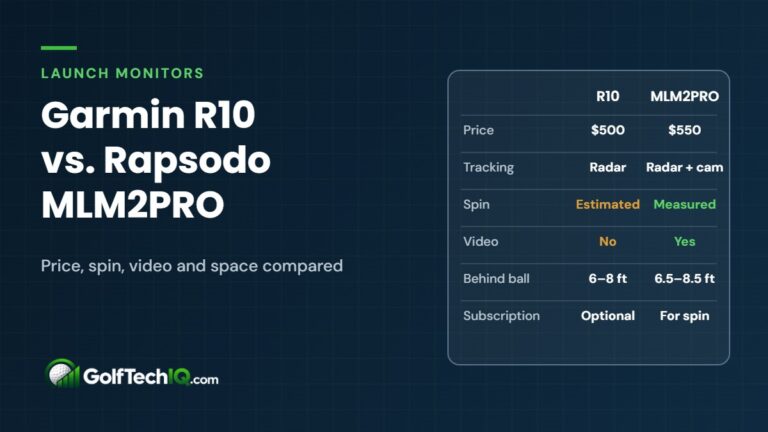 Garmin R10 vs. Rapsodo MLM2PRO: Which Launch Monitor Should You Buy?
The Rapsodo MLM2PRO measures spin and records impact video but needs a Premium membership; the Garmin R10 is simpler and…
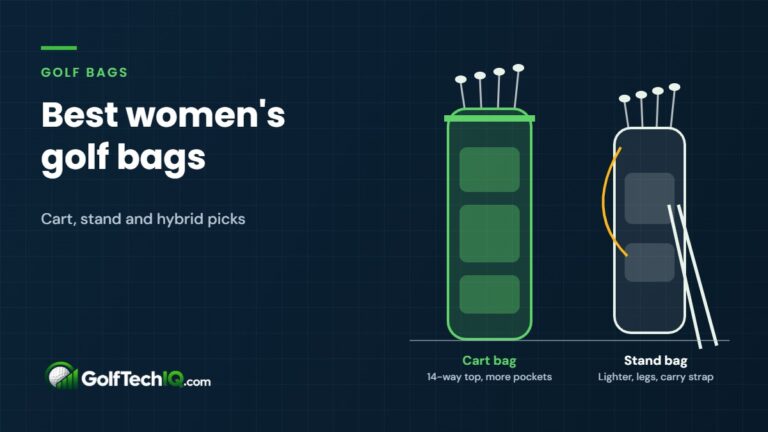 Best Women’s Golf Bags (2026): Cart and Stand Bag Picks
The best women's golf bags for riding or walking: cart, stand and hybrid bags compared on weight, dividers, pockets and…
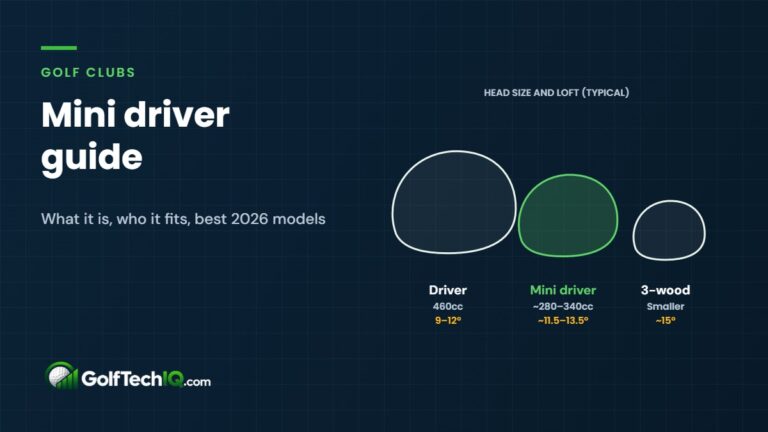 Mini Driver Guide: What It Is and the Best Mini Drivers (2026)
What a mini driver is, who should use one, how it compares with a driver and 3-wood, and the best…