

GolfTechIQ is reader-supported. When you buy through links on this page, we may earn a commission at no extra cost to you. As an Amazon Associate, we earn from qualifying purchases.
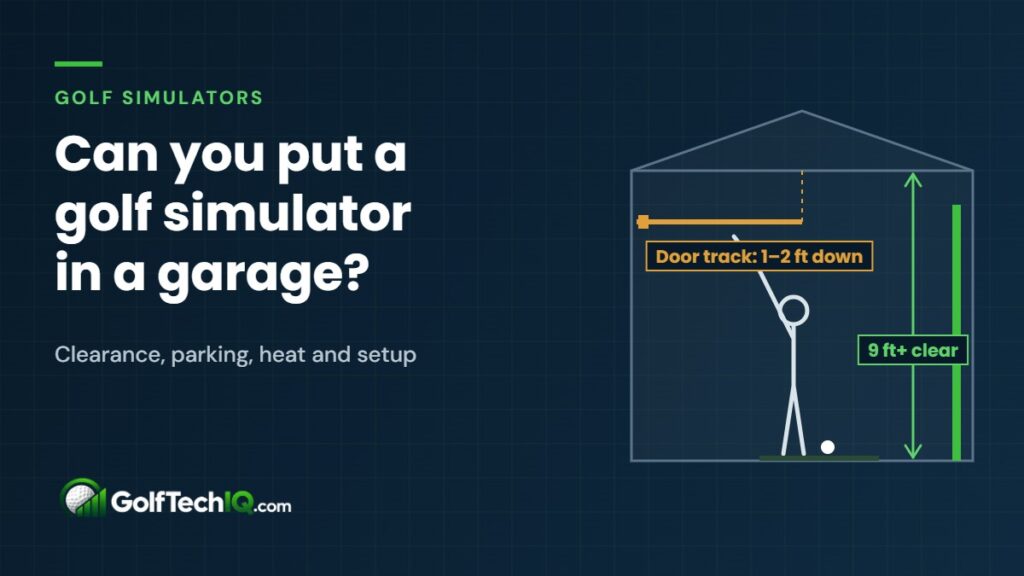
Short answer: yes. A garage is often the best room in the house for a golf simulator, because a standard two-car garage is about 20 × 20 feet or larger, which covers the width and depth most setups need. The catch is height: garage door tracks and openers can hang 1–2 feet below the ceiling, so measure to the lowest point above where you’ll swing, not to the ceiling itself. Plan for at least 9 feet of clear height for a driver.
Below is everything to check before you buy: clearance, keeping your car in the garage, heat and cold, light, and the equipment that makes a garage setup work. To check your exact space, use our golf simulator room size calculator.
Will it fit? Typical garage sizes
| Garage | Typical interior size | Golf simulator fit |
|---|---|---|
| Two-car (minimum) | 20 × 20 ft | Fits most setups if the ceiling clears |
| Two-car (most common) | 24 × 24 ft | Room for the sim plus storage, even radar units |
| Deep two-car | 20 × 28–30 ft | Great for radar launch monitors that sit behind the ball |
| One-car | Roughly 12 × 20 ft | Tight on width; a side-of-ball unit and a smaller screen help |
For comparison, most golfers need about 10 feet of ceiling, 15 feet of width and 18 feet of depth for a comfortable full setup. See how much space you need for a golf simulator for the full breakdown.
The garage door is the real problem
Most garages have 8–9 foot ceilings, which is already borderline for a driver. The door hardware makes it worse:
- Door tracks often sit 1–2 feet below the ceiling when the door is open.
- The opener and rail run down the middle of the ceiling, often right above where you’d swing.
- An open door can hit a ceiling-mounted projector or overhead launch monitor.
Ways around it:
- Hit facing the back wall, with your hitting mat placed where the open door doesn’t hang overhead.
- Keep the door closed while you play, so the panels sit vertically and the ceiling above you is clear.
- Swap to a wall-mounted (jackshaft) opener, which mounts beside the door instead of on the ceiling. It’s a common upgrade for garage sims, but get a quote from a garage door installer.
- Do the broomstick test: make slow swings with your driver where the mat will go before you buy anything.
Can you still park in the garage?
Yes, if you choose equipment that packs away. A retractable impact screen rolls up toward the ceiling, the hitting mat and turf can be rolled or slid to the side, and a portable launch monitor goes on a shelf. Many garage golfers set up in a few minutes and park the car back in afterward. If you want a permanent bay, plan to give up one parking spot in a two-car garage.
See retractable golf screens on Amazon
Heat, cold and humidity
Garages usually aren’t climate-controlled, and electronics care. Garmin, for example, lists an operating range of 14°F to 131°F for its Approach R50, and warns that it can overheat and shut off above that. A closed garage in a hot climate can get close to that in summer.
- Hot climates: don’t store the launch monitor, laptop or projector in the garage in summer, and add a fan or portable AC while you play.
- Cold climates: a portable garage heater or insulated garage door makes winter sessions realistic.
- Year-round use: a mini-split heat pump is the most comfortable option.
- Humid areas: run a dehumidifier to protect the screen and electronics.
Projector and lighting
A short-throw projector is the standard choice because it can sit close to the screen and out of your swing path. BenQ, for example, recommends a throw ratio of about 0.69–0.89 for golf simulators so the projector stays clear of the hitting area without casting shadows. Mount it where the garage door won’t hit it.
For light, you want the hitting area bright but the screen dark. Bright overhead garage lights wash out the picture, so dimmable LED fixtures aimed at the hitting area work best.
See short-throw golf projectors on Amazon
Which launch monitor works best in a garage?
- Deep garage (20+ feet of depth): any type works, including radar units like the Garmin R10 and Rapsodo MLM2PRO that sit 6–8 feet behind the ball. See our Garmin R10 vs. Rapsodo MLM2PRO comparison.
- Shallow garage or a car parked behind you: choose a unit that sits beside the ball. See best launch monitors for small rooms.
- Low ceiling because of door hardware: avoid ceiling-mounted launch monitors.
Garage golf simulator checklist
- Ceiling height measured to the lowest door track or opener above your swing
- Swing tested with a driver where the mat will go
- Width checked for your handedness (and for lefties if they’ll play too)
- Depth checked for your launch monitor type
- Plan for the car: permanent bay or a setup that packs away
- Heat, cold and humidity plan for the electronics
- Outlet near the hitting area for the projector and computer
- Short-throw projector mounted clear of the door path
See golf hitting mats on Amazon
FAQ
Is a one-car garage big enough for a golf simulator?
Often, if the ceiling clears. Width is the usual limit, so use a narrower screen, set the hitting mat for your handedness, and choose a launch monitor that sits beside the ball.
Can I use a golf simulator with the garage door open?
You can, but an open door lowers your clear height and lets in light that washes out the projector image. Most garage golfers play with the door closed.
Can I leave my launch monitor in the garage?
Check its operating and storage temperature range. In very hot or very cold climates, it’s safer to store the launch monitor, laptop and projector indoors.
Sources: BenQ, garage golf simulator setup; Angi, two-car garage dimensions; Garmin, Approach R50 operating temperature.
Keep reading
 Ceiling Height for a Golf Simulator: How High Is High Enough?
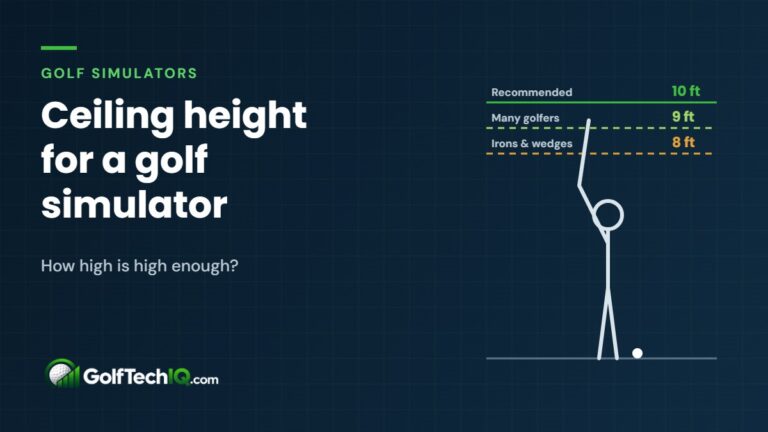
Plan on a 10-foot ceiling to swing a driver freely in a golf simulator; many golfers can make 9 feet…
 Golf Simulator for Home: How to Choose the Right Setup (2026 Guide)
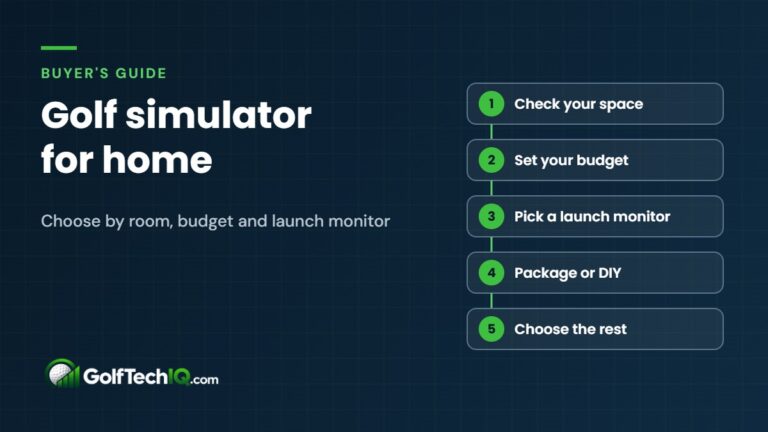
Choosing a golf simulator for home comes down to your room, your budget and a launch monitor that fits both.…
 How Much Does a Golf Simulator Cost? Real Budgets from $1,000 to $15,000+
A home golf simulator costs about $1,000 for a practice setup, $5,000 to $7,000 for a full simulator and $15,000+…