

GolfTechIQ is reader-supported. As an Amazon Associate, we earn from qualifying purchases.
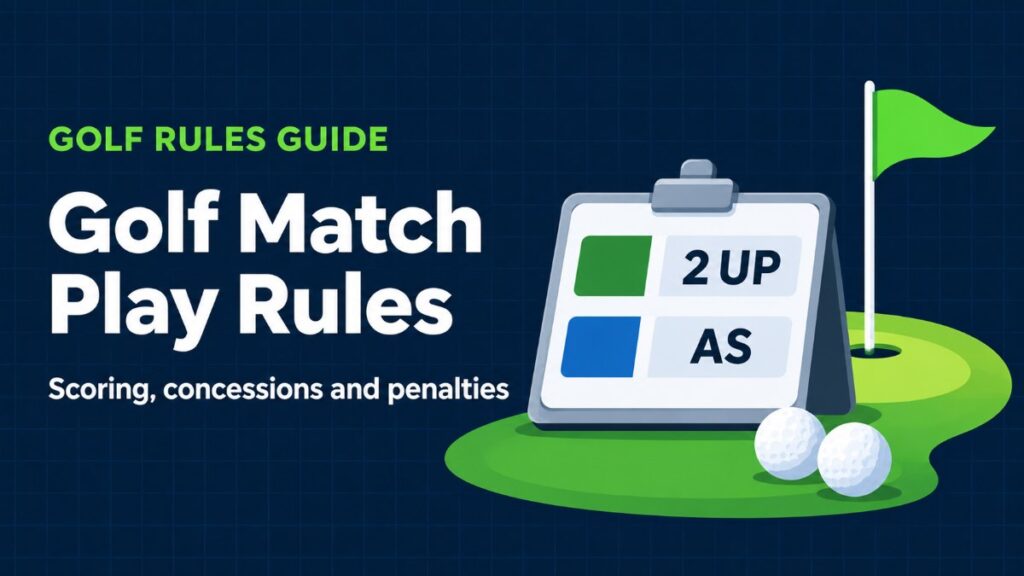
Short answer: in match play you compete hole by hole, not by total strokes. Win a hole by taking fewer strokes than your opponent, tie (halve) it with the same score, and win the match once you’re ahead by more holes than are left to play. Most Rules of Golf work the same as in stroke play, with three big differences: you can concede putts, holes or the whole match; the general penalty is loss of hole instead of two strokes; and your opponent can make you replay a shot hit out of turn.
How match play scoring works
| Term | Meaning |
|---|---|
| 1 up, 2 up… | You’ve won that many more holes than your opponent |
| All square (AS) | The match is tied |
| Halved | A hole (or the match) ends in a tie |
| Dormie | You’re up by exactly as many holes as remain, so you can’t lose in regulation |
| 3 & 2 | Won 3 up with 2 holes left; the match ends early |
| 1 up | Won by one hole on the final hole |
Because only the hole matters, a blow-up 9 costs you one hole, no more. That changes strategy: you can take more risks when your opponent is already in trouble, and play safe when they’re in the fairway.
Concessions
Under Rule 3.2b, you can concede your opponent’s next stroke, a hole or the whole match at any time before it’s decided. A concession only needs to be clear, by words or an obvious gesture such as knocking the ball away. Once made, it’s final and can’t be declined or taken back. That’s why “that’s good” on a short putt is a real ruling in match play, not just a courtesy. Concessions don’t exist in stroke play, where everyone must hole out.
Order of play and the honor
- First tee: the honor is decided by the draw, or by agreement or a coin toss.
- Later tees: whoever won the previous hole tees off first. After a halved hole, the honor stays with the player who had it.
- After the tee: the ball farther from the hole is played first.
- Playing out of turn: there’s no penalty, but your opponent may cancel the stroke and make you play again in the right order. They can use that if you hit a great shot.
Penalties in match play
Rules with a one-stroke penalty, such as taking unplayable-ball relief or accidentally moving your ball, cost one stroke in match play too. The difference is the general penalty: breaches that cost two strokes in stroke play, such as hitting the wrong ball or improving your lie, cost you the hole in match play.
Telling your opponent your score
If your opponent asks how many strokes you’ve taken, you must answer correctly, and you must tell them about any penalty you’ve incurred as soon as reasonably possible. Giving the wrong number, and not fixing it in time, generally costs you the hole. If you think your opponent broke a rule, raise it promptly, before either of you tees off on the next hole.
Handicaps in match play
In a handicap match, the higher-handicap player usually receives the difference between the two Course Handicaps, applied on the hardest holes first using the stroke index on the scorecard. For example, if you play off 18 and your opponent plays off 10, you receive 8 strokes, one on each of the holes rated 1 through 8. Find your number with our golf handicap calculator.
Popular match play formats
| Format | How it works |
|---|---|
| Singles | One player against one player |
| Four-ball | Two-person teams; each player plays their own ball and the better score on each hole counts |
| Foursomes (alternate shot) | Two-person teams share one ball and take turns hitting it |
| Nassau | Three matches in one: front nine, back nine and overall 18 |
Want a different points game? See Stableford scoring explained.
FAQ
What happens if a match is tied after 18 holes?
It depends on the competition. In casual play it can stand as a halved match. In tournaments, players usually go to extra holes until someone wins one.
Can I concede a putt I’ve already started?
You can concede your opponent’s next stroke at any time before it’s made. Once their ball is moving, it’s too late to concede that stroke.
Can players agree to waive a rule in match play?
No. Players can’t knowingly agree to ignore a rule or penalty. Doing so can disqualify both of them.
Is match play or stroke play better for beginners?
Match play is often more forgiving, since one bad hole costs a single hole and you can pick up once the hole is lost.
Sources: R&A, Rules of Golf Rule 3; USGA, Player’s Edition Rule 3; R&A, Match Play Rules.
Keep reading
 Golf Scoring Terms: Birdie, Eagle, Bogey and More
Every golf scoring term explained, from birdie and bogey to albatross, condor, net score and match play terms, with a…
 TaylorMade Spider Putter Guide (2026): Every Model Compared
Every 2026 TaylorMade Spider putter compared, from the $349.99 Spider Tour family to the zero-torque Spider ZT Max, plus how…
 Mini Golf Rules: How to Play and Score Putt Putt
The standard mini golf (putt putt) rules: stroke limits, out-of-bounds and wall rules, scoring, tiebreakers, etiquette and tips for a…