

GolfTechIQ is reader-supported. As an Amazon Associate, we earn from qualifying purchases.
Short answer: For most golfers the best golf grip is the Golf Pride Tour Velvet at about $7 a club: all-weather rubber, medium feel, sizes from undersize to jumbo. If you want more traction in wet or hot weather, step up to the Golf Pride MCC or MCC Plus4 (about $13). If your hands ache or you squeeze too hard, the Golf Pride CP2 Wrap (about $11) or Winn Dri-Tac (about $10) are the soft picks. Get the size right first, because the wrong size matters more than the brand.
We didn’t test these ourselves. We picked them by the numbers: size range, material and firmness, published weight, price per club and how widely they’re available to replace later. Prices below are typical single-grip retail prices from authorized dealers and big-box golf stores; they change often, so treat them as “about”.
Best golf grips at a glance
| Grip | Material | Feel | Best for | Price per grip |
|---|---|---|---|---|
| Golf Pride Tour Velvet | Rubber | Medium | Most golfers, best value | about $7 |
| Golf Pride MCC | Hybrid (cord top, rubber bottom) | Medium-firm | Wet or sweaty hands | about $13 |
| Golf Pride MCC Plus4 | Hybrid, built-up lower hand | Medium-firm | Lighter grip pressure | about $13 |
| Golf Pride CP2 Wrap | Soft rubber | Soft | Sore hands, arthritis | about $11 |
| Golf Pride Z-Grip Cord | Full cord | Firmest | Fast swings, rain | about $13 |
| Golf Pride MCC Plus4 ALIGN | Hybrid with rib | Medium-firm | Consistent hand placement | about $15 |
| Lamkin Crossline / SuperStroke Crossline 2.0 | Rubber | Medium-firm, tacky | Budget full-bag regrip | about $6-7 |
| Lamkin Sonar+ / SuperStroke REVL | Rubber or half cord | Medium to soft | Tacky feel, cold weather | about $8-10 |
| Winn Dri-Tac | Polymer | Soft, tacky | Comfort, less hand fatigue | about $10 |
Grip size: start with your glove
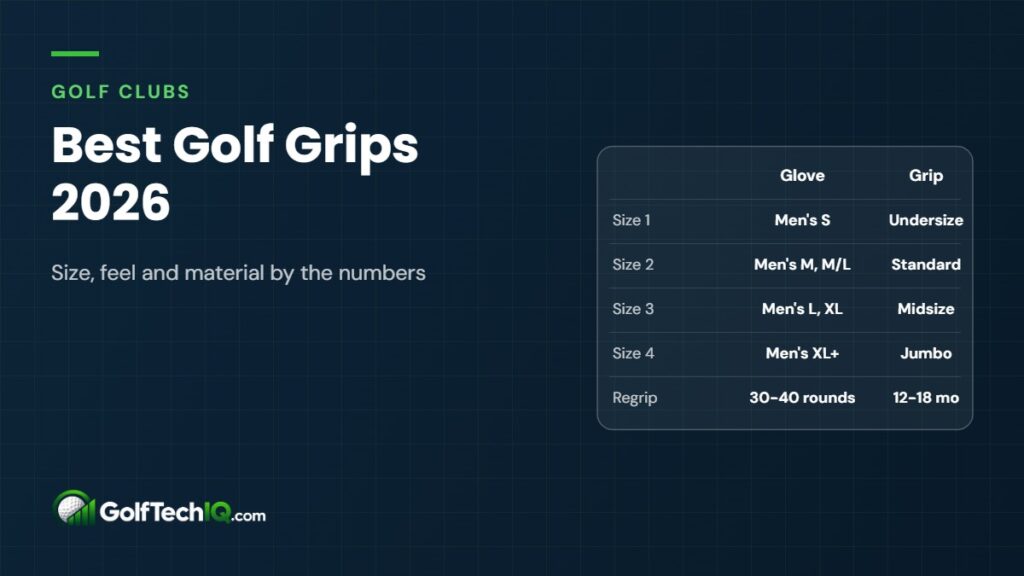
Size is the decision that changes how the club feels in your hands most. A grip that’s too small lets your hands get overactive and can encourage a closed face. A grip that’s too big can make it harder to release the club. Golf Pride’s sizing chart ties grip size to hand length (wrist crease to middle fingertip) and glove size:
| Grip size | Hand length | Typical glove size |
|---|---|---|
| Undersize | 5″ to 6.5″ | Men’s S; Women’s S or M |
| Standard | 6.6″ to 7.5″ | Men’s M or M/L; Women’s M/L or L |
| Midsize | 7.6″ to 9″ | Men’s L or XL |
| Jumbo | Over 9″ | Men’s XL to XXXL |
A quick check: hold the club with your lead hand. The fingertips of that hand should just touch the heel pad. If they dig into the pad, the grip is too small. If there’s a gap, it’s too big.
In practice, midsize grips are usually about 1/16″ bigger than standard, and oversize or jumbo grips about 1/8″ bigger. If you land between sizes, add two to four extra wraps of build-up tape under a standard grip instead of jumping a full size. Many golfers with arthritis or joint pain also go up a size because a thicker handle takes less squeezing.
One detail most buyers miss is core size. A grip with a .580″ core stretched over a .600″ shaft butt installs slightly bigger and firmer than its label says. The Lamkin Crossline, for example, uses a .580″ core, while Winn Dri-Tac and most standard Golf Pride grips are listed at .600″. If your new grips feel chunkier than your old ones, that’s usually why.
Materials: rubber, cord and hybrid
- Rubber: The default. Comfortable, cheap and fine in most weather. Tour Velvet, Crossline and REVL Player are all-rubber grips.
- Full cord: Cotton cord woven into the rubber. Rough, firm and the best traction when hands are wet. It can feel harsh if you play without a glove or rarely see rain. Z-Grip Cord is the classic example.
- Hybrid: Cord where the top hand goes, softer rubber under the bottom hand. You get traction where you need it and comfort where you don’t. Golf Pride MCC and SuperStroke REVL Element are hybrids.
- Soft polymer or soft rubber: Tacky, cushioned and easy on the hands. Winn Dri-Tac and Golf Pride CP2 Wrap fit here. They tend to wear faster than firmer compounds.
Feel and firmness
Firm grips transmit more feedback from the clubhead and twist less in the hands, which faster swingers tend to like. Soft grips damp vibration and let you hold the club more lightly, which helps if you tend to choke the handle or play in cold weather. A rough ladder from softest to firmest: Winn Dri-Tac and CP2 Wrap, then Tour Velvet and REVL Player, then MCC and REVL Element, then Z-Grip Cord.
Taper matters too. “Plus4” (Golf Pride) and “4X” (SuperStroke) grips have less taper, so the lower-hand section is thicker. The idea is that the lower hand doesn’t take over, and you can grip with less tension without changing the top-hand size.
Grip weight and swing weight
Grips are not weightless. A standard swing grip weighs about 48 to 54 grams, and bigger sizes add a lot. Published weights from retailers and SuperStroke:
| Grip | Standard | Midsize | Jumbo |
|---|---|---|---|
| Golf Pride Tour Velvet | about 50 g | n/a | n/a |
| Lamkin Crossline | 50 g | 62 g | 76 g |
| SuperStroke Crossline 2.0 | 49.5 g | 64 g | 81 g |
| SuperStroke REVL Comfort | 54 g | 64 g | 81 g |
| Winn Dri-Tac | 48 g | 49 g | 50 g (oversize) |
The club-fitter rule of thumb is that about 4 grams at the grip end changes swing weight by about one point. A heavier grip makes the head feel lighter; a lighter grip makes it feel heavier. So switching from a 50 g standard Crossline to a 76 g jumbo is a 26 g jump, or roughly six swing weight points lighter in feel (for example D2 dropping toward C6). Total club weight goes up, but the head feels lighter.
For most weekend golfers a point or two doesn’t matter much. If you’re going two sizes up, or you like your clubs’ current balance, pick a lightweight large grip (Winn’s midsize and oversize add only a gram or two) or ask the shop to check swing weight after installing. Extra layers of tape add weight as well, though far less than a size change.
How often to regrip
The common guideline from PGA professionals is every 12 to 18 months, or about every 30 to 40 rounds. Range sessions count too. Golfers who practice several times a week may need fresh grips every 6 to 9 months. Heat, sun and garage storage all age rubber faster.
| How much you play | Regrip about every |
|---|---|
| Under 20 rounds a year | 18 to 24 months, or when worn |
| 20 to 40 rounds a year | 12 to 18 months |
| 40+ rounds, or weekly range work | 6 to 12 months |
Signs it’s time: shiny or slick spots where your thumbs sit, a hard or cracked surface, faded texture, or catching yourself squeezing harder to stop the club from turning. Washing grips with warm water and mild soap restores some tack but won’t bring back a hardened compound.
Cost per club: DIY vs shop
The grip itself is most of the cost. Labor is cheap at the big stores: Golf Galaxy lists $3.99 per club for standard grips, and PGA TOUR Superstore lists installs starting around $0.99 per club. Independent shops vary.
| Grip | DIY (grip only) | Shop installed (about) | 13 clubs, shop |
|---|---|---|---|
| Crossline 2.0 | about $6 | $7 to $10 | $90 to $130 |
| Tour Velvet | about $7 | $8 to $11 | $105 to $145 |
| Winn Dri-Tac | about $10 | $11 to $14 | $145 to $180 |
| CP2 Wrap | about $11 | $12 to $15 | $155 to $195 |
| MCC / MCC Plus4 | about $13 | $14 to $17 | $180 to $220 |
| MCC Plus4 ALIGN | about $15 | $16 to $19 | $210 to $250 |
DIY adds tape, solvent and a hook blade, plus a rubber vise clamp if you don’t have one. Many retailers sell 13-grip bundles that include tape and solvent. DIY mostly saves money when you’d otherwise pay $4 or more per club in labor, or when you’ll regrip more than once. The bigger win is doing it on your schedule. If you’re buying new clubs anyway, like a beginner-friendly driver or a mini driver, ask the store to install your preferred grip at purchase.
Best overall: Golf Pride Tour Velvet
The Tour Velvet is the benchmark for a reason. It’s an all-rubber grip with a medium feel that’s neither squishy nor hard, it works in most weather, and at about $7 it’s one of the cheapest name-brand grips you can buy. It comes in undersize, standard, midsize and jumbo, plus a Plus4 version with a thicker lower hand, a logo-free 360 version and a lighter Lite version. Standard weight is about 50 g, close to what most stock grips weigh, so swapping in standard size barely changes swing weight.
- Pros: Low price, every size, neutral feel, easy to find anywhere.
- Cons: Less traction than cord when it’s wet; plain look.
Best for all weather: Golf Pride MCC and MCC Plus4
The MCC (Multi-Compound) puts brushed cotton cord under the top hand and softer rubber under the bottom hand. That gives grip in rain and humidity without the full harshness of an all-cord grip. The MCC Plus4 keeps the same build but adds roughly four wraps’ worth of thickness to the lower hand, which many golfers like for lighter grip pressure. Both run about $13 and come in standard and midsize, with a jumbo option for the Plus4. If you sweat a lot or play in the morning dew, this is the upgrade.
- Pros: Excellent wet traction, comfortable lower hand, very popular so easy to match later.
- Cons: Nearly double the Tour Velvet’s price; cord can feel rough without a glove.
Best soft grip for sore hands: Golf Pride CP2 Wrap
The CP2 Wrap uses a soft, tacky rubber with a firmer inner core that Golf Pride says reduces torque, so the grip doesn’t feel mushy when you swing hard. Golf Pride specifically points golfers with arthritis or hand pain to its CP-series grips. At about $11 it’s priced between the Tour Velvet and MCC, and it comes in standard, midsize and jumbo.
- Pros: Very soft, vibration damping, jumbo option.
- Cons: Soft compounds wear faster; not ideal in heavy rain.
Best for fast swings: Golf Pride Z-Grip Cord
The Z-Grip Cord is Golf Pride’s firmest, most abrasive option: full cord with a Z-shaped texture. It’s built for players who want maximum feedback and no twisting at high swing speeds. Check your speed with our swing speed and distance calculator; if you’re well above average, a firm grip like this makes more sense. About $13 in standard and midsize. Skip it if you play gloveless or want comfort first.
Best for hand placement: Golf Pride ALIGN
ALIGN grips add a raised rib down the back so your fingers find the same spot every time, and you can feel if the face is open or closed at address. The most common version is the MCC Plus4 ALIGN at about $15, and an ALIGN MAX version has a bigger rib. ALIGN is also offered on the Tour Velvet and Z-Grip. The catch: the rib must be installed perfectly straight, so these are less forgiving for first-time DIY regrippers.
Best budget: Lamkin Crossline (now SuperStroke Crossline 2.0)
The Lamkin Crossline has long been the cheapest good grip, with a medium-firm, tacky rubber and a crosshatch pattern for about $6.50 to $7. SuperStroke bought Lamkin in 2024, and some retailers have stopped restocking Lamkin-branded grips. The successor is the SuperStroke Crossline 2.0 at about $6, built from soft Genesis rubber with a reduced taper (fuller lower hand). It comes in undersize, standard, midsize and jumbo, plus a full-cord version for about $10. Remember the original Crossline’s .580″ core, which installs slightly larger on standard shafts.
- Pros: Lowest price for a name brand, four sizes, cord option.
- Cons: Lamkin-branded stock is thinning; large sizes are heavy (81 g jumbo).
Best tacky rubber: Lamkin Sonar+ and SuperStroke REVL
The Lamkin Sonar+ is a tacky Genesis-rubber grip that runs slightly larger than standard. You can still find it at some stores, but SuperStroke’s REVL line is the go-forward version. There are three main models:
- REVL Player (about $8): All rubber, firm classic feel, 49.5 g standard. The closest swap for Sonar+.
- REVL Element (about $10): Half cord, firmer top hand and softer bottom hand, 46.5 g standard. SuperStroke’s answer to the MCC.
- REVL Comfort (about $9): Softest, wrap style, fuller lower hand, 54 g standard. The closest swap for Sonar+ Wrap.
SuperStroke says the REVL rubber resists UV and ozone and stays soft in cold weather. These are a good alternative if you like a tackier surface than Golf Pride rubber.
Best for comfort: Winn Dri-Tac
Winn’s Dri-Tac uses a soft polymer instead of rubber. It’s cushioned, tacky and designed to reduce hand fatigue. Its standout spec is weight: 48 g standard, 49 g midsize and 50 g oversize, so going bigger barely changes swing weight. That makes it a smart pick for golfers who want a larger grip without the head feeling lighter. Expect about $10 to $12, or about $8.50 to $10.70 for the newer Dri-Tac 2.0, which adds an undersize option.
- Pros: Very comfortable, light even in big sizes, all-weather tread.
- Cons: Soft polymer wears faster; less feedback than firm rubber or cord.
How to regrip a golf club yourself
You need a hook blade, double-sided grip tape, grip solvent, a rubber shaft clamp and vise (or a helper), and a towel. Expect about 5 to 10 minutes per club once you have a rhythm.
- Clamp and cut: Clamp the shaft in a rubber shaft holder. Cut the old grip off with a hook blade, pulling the blade away from you.
- Remove old tape: Peel off the old tape. Solvent or a heat gun helps soften stubborn adhesive.
- Apply new tape: Run a strip of double-sided tape slightly longer than the grip down the shaft, wrap it, then twist the overhang and tuck it into the shaft end. Add extra layers here if you want to build up size (up to about four wraps).
- Add solvent: Cover the grip’s vent hole, pour solvent inside, shake to coat, and pour the excess over the taped shaft.
- Slide it on: Push the grip on in one smooth motion until the shaft butt hits the end cap.
- Align quickly: Before the solvent sets, twist the grip so the logo or ALIGN rib is straight with the clubface square. Sight down the shaft to check.
- Let it dry: Wipe off excess solvent and wait at least a few hours (Golf Pride says about three to four) before hitting balls.
Once they’re dry, test them on the range or at home on a golf hitting mat. While you’re refreshing the bag, a good golf bag with a full-length divider helps keep new grips from rubbing and tangling.
Who should buy which grip
- Not sure, want value: Tour Velvet in your glove size.
- Sweaty hands, wet climate: MCC, or Z-Grip Cord if you swing fast.
- Arthritis or hand pain: CP2 Wrap or Winn Dri-Tac, one size up.
- Grip too tight with the lower hand: MCC Plus4, Tour Velvet Plus4 or REVL Comfort.
- Tightest budget: Crossline 2.0.
FAQ
What are the best Golf Pride grips?
For most golfers, the Tour Velvet (about $7) for value, the MCC or MCC Plus4 (about $13) for all-weather traction, and the CP2 Wrap (about $11) for comfort. The Z-Grip Cord suits fast swingers who want a firm feel.
What size golf grip do I need?
Match your glove: men’s medium or M/L usually fits standard, large to XL fits midsize, and XL and up fits jumbo. Men’s small and most women’s small and medium gloves fit undersize. If you’re between sizes, add a few wraps of tape under a standard grip.
Do bigger grips change swing weight?
Yes. About 4 grams at the grip end equals one swing weight point. A heavy jumbo grip can make the head feel several points lighter. Winn Dri-Tac is an exception, adding only a gram or two from standard to oversize.
How often should I regrip my clubs?
About every 12 to 18 months or 30 to 40 rounds, sooner if you practice a lot or the grips feel slick or hard.
How much does it cost to regrip a set of clubs?
For 13 clubs, roughly $90 to $145 with budget grips like Crossline 2.0 or Tour Velvet at a big-box store, and about $180 to $250 with MCC or ALIGN grips. DIY saves the labor, which is often only $1 to $4 per club.
Are Lamkin grips still made?
SuperStroke bought Lamkin in 2024. Some Lamkin grips are still sold, but several retailers now carry SuperStroke’s Crossline 2.0 and REVL grips instead, which are built on Lamkin designs and rubber.
Sources: Golf Pride grip size guide, Golf Pride ALIGN MAX installation guide, MyGolfSpy Golf Pride grip comparison, Grips4Less Golf Pride prices, Grips4Less on Lamkin changes, Grips4Less SuperStroke REVL specs, Golf Galaxy Winn Dri-Tac, Golf Galaxy Lamkin Crossline, Golf Monthly on regrip frequency, ThePricer regrip cost guide.
Keep reading
 Best and Most Forgiving Drivers of 2026: 7 Highest-MOI Picks by Brand
The most forgiving golf drivers of 2026, picked by MOI, launch and price: Ping G440 K, Cobra OPTM Max-K, TaylorMade…
 Best Driver for a Slice (2026): 6 Anti-Slice Drivers That Straighten Your Drives
The best golf drivers for slicers in 2026: Ping G440 SFT, Callaway Quantum Max D, Cobra OPTM Max-D and budget…
 Best Golf Drivers of 2026: Picks for Forgiveness, Low Spin, Slices and Seniors
The best 2026 golf drivers sorted by what you need: forgiveness, low spin, slice correction, budget and slower swing speeds.