

GolfTechIQ is reader-supported. As an Amazon Associate, we earn from qualifying purchases.
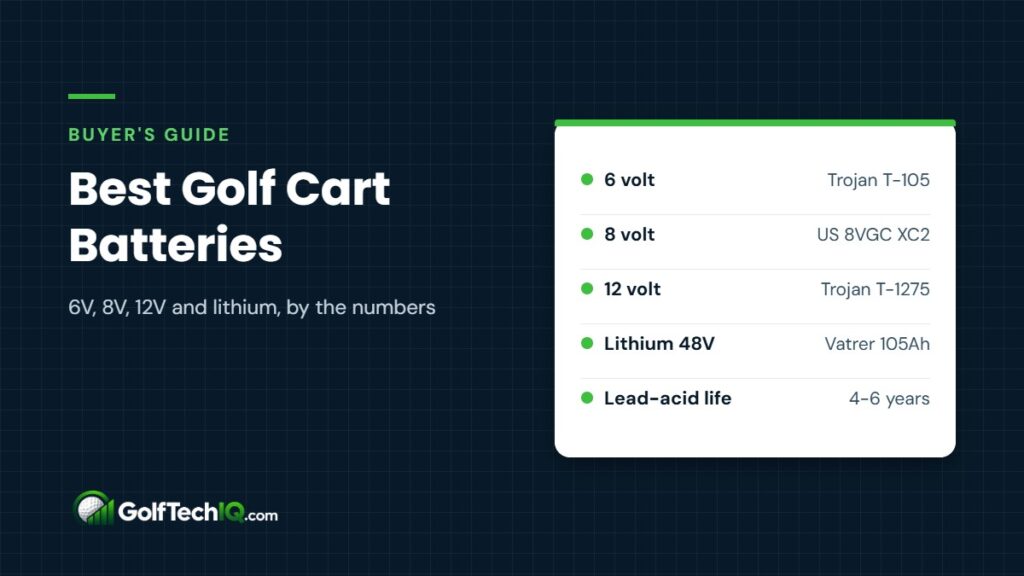
Short answer: The best golf cart batteries are the ones that match your pack: count the batteries and read the voltage on top. For 6 volt golf cart batteries, the Trojan T-105 (225Ah) and U.S. Battery US 2200 XC2 (232Ah) are the standard picks. For 8 volt golf cart batteries, the U.S. Battery US 8VGC XC2 (170Ah) is the go-to, and for 12-volt packs the Trojan T-1275 (150Ah). If you want to stop watering batteries for good, a 48V lithium kit like the Vatrer 48V 105Ah (about $1,580) replaces the whole set at roughly a quarter of the weight.
This guide covers replacement batteries for electric golf carts (the vehicle): how 36V and 48V packs are built, the best 6-volt, 8-volt and 12-volt lead-acid batteries, lithium conversion kits, what they cost, how long they last and how to handle them safely. Picks are made by the numbers: capacity, published runtime, weight, warranty and price. We have not tested these batteries hands-on. Shopping for a push cart for your bag instead? See our best golf push cart guide.
Prices are typical U.S. retail as of November 2026 from brand sites and battery retailers. They change often, especially around Black Friday, and heavy lead-acid batteries often ship by truck freight at extra cost. GolfTechIQ may earn a commission if you buy through links on this page.
Best golf cart batteries at a glance
| Battery | Best for | Typical price | Why |
|---|---|---|---|
| Trojan T-105 (6V, 225Ah) | 6-volt packs | About $230 each; about $1,390 for six | The long-time standard 6-volt golf cart battery |
| U.S. Battery US 2200 XC2 (6V, 232Ah) | 6-volt packs, more capacity | Check current price | 122 minutes at 75A, same GC2 size |
| U.S. Battery US 8VGC XC2 (8V, 170Ah) | 48V carts with six 8V | Check current price | Standard 8-volt golf cart battery |
| Trojan T-1275 (12V, 150Ah) | 48V carts with four 12V | Check current price | Fewer batteries to wire and water |
| Vatrer 48V 105Ah LiFePO4 | Lithium conversion | About $1,580 | 4,000 cycles, charger and monitor included |
| ECO Battery GEN3 51V 60Ah bundle | Club Car lithium swap on a budget | Check current price | Bundle made for Club Car Precedent, Onward, Tempo |
| Flow-Rite Pro-Fill watering kit | Any flooded lead-acid pack | Check current price | Waters every cell from one fill point |
How golf cart battery packs work
Golf carts run on a pack of batteries wired in series, so the voltages add up. Most carts are either 36 volts or 48 volts. To find yours, count the batteries and multiply by the number printed on each one (or count the vent caps: each cell is 2 volts, so a 6-volt battery has 3 caps and an 8-volt has 4).
| System | Battery layout | Batteries to buy | Notes |
|---|---|---|---|
| 36V | 6 x 6V | 6 | Common on older carts |
| 48V | 6 x 8V | 6 | A very common 48V layout |
| 48V | 8 x 6V | 8 | More capacity per battery, more weight |
| 48V | 4 x 12V | 4 | Fewer batteries to wire and water |
| 48V (51V nominal) lithium | 1 lithium pack | 1 | Replaces any of the 48V lead-acid layouts |
Capacity is rated in amp-hours (Ah). More amp-hours generally means more range, but you can only compare Ah within the same voltage. A better side-by-side is the published runtime at a steady draw. U.S. Battery lists these figures at 75 amps:
| U.S. Battery model | Voltage | 20-hr capacity | Minutes at 75A | Weight |
|---|---|---|---|---|
| US 1800 XC2 | 6V | 208Ah | 107 | 55 lb |
| US 2200 XC2 | 6V | 232Ah | 122 | 62 lb |
| US 125 XC2 | 6V | 242Ah | 140 | 66 lb |
| US 8VGC XC2 | 8V | 170Ah | 82 | 62 lb |
| US 12VRX XC2 | 12V | 155Ah | 77 | 86 lb |
Always replace a lead-acid pack as a full set with the same model and voltage. One new battery in a string of old ones gets overworked and the whole pack wears out faster.
Best 6 volt golf cart batteries
Trojan T-105 (about $230 each)
The T-105 is the 6-volt flooded battery most golf cart owners know by name. It is rated at 225Ah at the 20-hour rate, weighs about 62 pounds and uses the standard GC2 size. Golf Cart Geeks lists a six-pack for a 36V cart at $1,389.99 and an eight-pack for a 48V cart at $1,799.99. Pick it if you want the safe, well-supported choice.
U.S. Battery US 2200 XC2 (check current price)
The US 2200 XC2 is the other common 6-volt golf cart battery, and it fits the same GC2 space as the T-105. U.S. Battery rates it at 232Ah and 122 minutes at 75 amps, at 62 pounds. Amazon sells it in sets of two, four, eight and more, so you can buy the exact count your cart needs. If you want a lighter, lower-capacity budget option, the US 1800 XC2 (208Ah, 55 lb) is also on Amazon.
Best 8 volt golf cart batteries
U.S. Battery US 8VGC XC2 (check current price)
Most 48V carts with six batteries use 8-volt batteries, and the US 8VGC XC2 is a standard pick. U.S. Battery rates it at 170Ah and 82 minutes at 75 amps, at 62 pounds, in the same footprint as a 6-volt GC2. Amazon lists it as a single and in four-, six- and eight-packs. A six-battery set weighs about 372 pounds, so plan on help or a dealer install.
Trojan’s 8-volt equivalent is the T-875: 170Ah at the 20-hour rate, 63 pounds and about 1.51 kWh per battery, per Trojan. We could not confirm a Trojan-brand T-875 listing on Amazon, so buy it from a local battery or golf cart dealer if you prefer Trojan.
Best 12 volt golf cart batteries
Trojan T-1275 (check current price)
Some 48V carts use four 12-volt batteries. The T-1275 is Trojan’s 12-volt GC12 battery, rated at 150Ah at the 20-hour rate, and Amazon lists it in sets of four and six. Four batteries mean fewer cables and fewer cells to water. The trade-off is weight per battery: the comparable U.S. Battery US 12VRX XC2 weighs 86 pounds each.
Best lithium golf cart batteries
A lithium golf cart battery (almost always LiFePO4) replaces the whole lead-acid pack with one box. It weighs around 100 pounds instead of 350 to 500, needs no watering and is rated for thousands of cycles. The catch is the upfront price and making sure the kit fits your cart.
Vatrer 48V 105Ah lithium golf cart battery (about $1,580)
Vatrer lists this pack at $1,579.99 on its own site (down from $2,399.99), and it is sold on Amazon. It is rated at 5.376 kWh, at least 4,000 cycles and 102.5 pounds, and Vatrer says it complies with UL 2271. The kit includes a 58.4V lithium charger and an LCD monitor with Bluetooth app. Vatrer advertises a 10-year warranty and up to 50 miles per charge, though real range depends on your cart, hills and load. A self-heating version is also on Amazon for owners who charge in freezing weather.
ECO Battery GEN3 51V 60Ah bundle for Club Car (check current price)
ECO Battery sells a GEN3 51V 60Ah bundle on Amazon made for Club Car Precedent, Onward and Tempo 48V carts. At 60Ah it holds a little over half the energy of a 105Ah pack, which is a fit for owners who drive short loops, like a round of golf or trips around the neighborhood. ECO Battery says its batteries carry a limited lifetime warranty; read the terms before you buy.
Other options: the Epoch 48V 105Ah complete kit lists at $2,299 at 18650 Battery Store. It is rated for 3,500+ cycles, weighs 99 pounds and carries an 11-year limited warranty (free repair or replacement in years one to five). It includes a charger, Bluetooth gauge, 48V-to-12V converter and cart-specific brackets and charge plug. We could not confirm that exact 105Ah kit on Amazon.
Lead-acid vs lithium golf cart batteries
| Factor | Flooded lead-acid | Lithium (LiFePO4) |
|---|---|---|
| Upfront cost (48V) | About $1,800 for eight Trojan T-105 | About $1,580 to $2,300 for a 105Ah kit |
| Weight | About 372 lb (six 8V) to 496 lb (eight 6V) | About 99 to 103 lb |
| Maintenance | Check and add distilled water, clean terminals | None beyond keeping it charged |
| Rated life | A retailer lists up to 1,200 cycles for the T-105; 4 to 6 years is typical | 3,500 to 4,000+ cycles per brand ratings |
| Warranty | Shorter; one retailer lists 1 year for the T-105 | 10 to 11 years advertised (Vatrer, Epoch) |
| Charger | Lead-acid charger | Must use a lithium charger |
For a 48V cart, lithium costs about the same as a premium lead-acid set and is rated to last far longer. Lead-acid still makes sense if you plan to sell the cart soon or need the lowest price for a 36V cart.
What a lithium conversion involves
- Match the voltage. A 48V cart needs a 48V (51.2V nominal) pack. 36V lithium packs exist for 36V carts.
- Check fit. Buy a kit listed for your brand, model and year. Cart-specific kits include brackets and the right charge plug.
- Use the lithium charger. Lead-acid chargers do not charge lithium correctly. Most kits include one.
- Plan for 12V accessories. If lights or a radio ran off one battery in the old pack, you need a 48V-to-12V converter.
- Check the current rating. The pack’s BMS (Vatrer lists 200A) should handle what your controller draws, especially on lifted or upgraded carts.
- Add a fuse or breaker. Epoch notes its kit does not include a main fuse or DC breaker, so buy one if your kit does not have it.
A golf cart shop can do the swap if you would rather not. If you do it yourself, follow the kit instructions and disconnect the old pack before you touch any wiring.
How long golf cart batteries last and what they cost
C2 Vehicles, a golf cart dealer, says lead-acid golf cart batteries typically last four to six years and that a replacement set can cost a thousand dollars or more. Lithium packs are rated for 3,500 to 4,000+ cycles and carry warranties of 10 to 11 years from brands like Vatrer and Epoch. Real life depends on how deep you drain the pack, how you store it and, for lead-acid, how well you keep up with watering.
| Pack | Typical cost | Expected life |
|---|---|---|
| 36V lead-acid (six Trojan T-105) | About $1,390 | About 4 to 6 years |
| 48V lead-acid (eight Trojan T-105) | About $1,800 | About 4 to 6 years |
| 48V lithium 105Ah (Vatrer) | About $1,580 | 4,000+ cycles rated, 10-year warranty advertised |
| 48V lithium 105Ah kit (Epoch) | About $2,300 | 3,500+ cycles rated, 11-year limited warranty |
Want the full picture on cart ownership costs? Our how much is a golf cart guide covers new and used cart prices, charging, insurance and registration.
Golf cart battery safety and care
Lead-acid batteries hold acid and give off gas while charging, and a full pack carries enough current to cause burns or fire if a wrench touches the wrong terminals. Trojan’s care advice for flooded batteries boils down to this:
- Wear safety glasses and gloves. If acid touches your skin or eyes, flush with water right away.
- Charge in a well-ventilated area, and keep flames, sparks and metal tools away from the batteries.
- Add distilled water, never acid. Water after a full charge, unless the plates are showing; then add just enough to cover them and charge first.
- Do not overfill. Fill to about 1/8 inch below the bottom of the vent well, then tighten the caps.
- Clean corrosion with baking soda and water, and coat terminals with protective spray or petroleum jelly.
- Store batteries fully charged in a cool, dry place. Never store a discharged pack.
For lithium packs, use only the charger made for the pack, choose a UL-listed battery, and do not charge a standard LiFePO4 pack below freezing. Vatrer says its BMS stops charging at 32°F; self-heating packs warm the cells first. Lithium packs are heavy too, so lift with a partner.
A single-point watering kit makes lead-acid upkeep much easier. The Flow-Rite Pro-Fill fills every cell from one hose and stops each cell at the right level.
How to choose golf cart batteries
- Count your batteries and read the voltage. Buy the same layout (6 x 6V, 6 x 8V, 8 x 6V or 4 x 12V) unless you go lithium.
- Measure the tray. GC2 6-volt and GC8 8-volt batteries share a footprint; 12-volt GC12 batteries are longer.
- Compare runtime, not just Ah. Minutes at 75A is the most useful number for a golf cart.
- Check date codes. Fresh lead-acid stock lasts longer; ask the seller how old the batteries are.
- Budget for a charger if you switch to lithium, and a 12V converter for accessories.
- Think about how long you will keep the cart. Lithium pays off the longer you own it.
Once the pack is sorted, our best golf cart accessories guide covers covers, seat covers, heaters, tires and wheels.
FAQ
Are 6 volt or 8 volt golf cart batteries better?
Neither is better on its own; buy what your cart was built for. A 48V pack of eight 6-volt batteries holds more amp-hours than six 8-volt batteries, but it weighs more and costs more. Six 8-volt batteries are a very common 48V layout.
Can I replace 8 volt batteries with 12 volt batteries?
Yes, four 12-volt batteries make the same 48 volts as six 8-volt batteries. You will need different cables and the 12-volt GC12 batteries must fit your tray. Compare runtime too: a U.S. Battery US 12VRX XC2 lists 77 minutes at 75A versus 82 for the US 8VGC XC2.
How long do golf cart batteries last?
Lead-acid golf cart batteries typically last four to six years with regular watering and charging. Lithium packs are rated for 3,500 to 4,000 or more cycles and carry warranties of 10 years or more from brands like Vatrer and Epoch.
How much do golf cart batteries cost?
A set of six Trojan T-105 6-volt batteries is about $1,390, and eight are about $1,800 at Golf Cart Geeks. A 48V 105Ah lithium kit costs about $1,580 to $2,300. Freight can add to lead-acid prices.
Can I replace just one golf cart battery?
Only if the rest of the pack is nearly new. A new battery in an old pack gets overworked, and the old ones keep dragging it down. In most cases, replace the full set at once.
Is a lithium golf cart battery worth it?
For most owners keeping a 48V cart for several years, yes. A lithium pack costs about the same as a premium lead-acid set, weighs about 270 to 395 pounds less, needs no watering and has a much longer warranty.
Sources: U.S. Battery flooded battery data sheet; Trojan T-875 product page; Trojan flooded battery maintenance guide; Northern Arizona Wind and Sun Trojan T-105; Golf Cart Geeks Trojan T-105 six-pack; Golf Cart Geeks Trojan T-105 eight-pack; Vatrer 48V 105Ah battery; Vatrer on self-heating lithium batteries; Epoch 48V 105Ah kit (18650 Battery Store); ECO Battery 48V lithium batteries; C2 Vehicles used Club Car Precedent guide. Prices checked November 6, 2026.
GolfTechIQ is reader-supported. When you buy through links on this page, we may earn a commission at no extra cost to you. As an Amazon Associate, we earn from qualifying purchases.
Keep reading
 Best Golf Cart Bag of 2026 (and Cart Bag vs Stand Bag)
The best golf cart bags of 2026 compared on dividers, pockets, weight and weather protection, plus how a cart bag…
 Best Golf Cart Accessories 2026: Covers, Seat Covers, Heaters, Tires and Wheels
The golf cart accessories worth buying: covers and enclosures, seat covers, propane and electric heaters, tires and wheels (with a…
 How Much Is a Golf Cart? 2026 Prices for New, Used and Street-Legal Carts
Real 2026 golf cart prices from manufacturer MSRPs and dealer listings: new gas, lead-acid and lithium carts, used carts, street-legal…