

GolfTechIQ is reader-supported. As an Amazon Associate, we earn from qualifying purchases.
Short answer: Yes, for most golfers who want a home simulator under $1,000, the Garmin Approach R10 is still the budget launch monitor to beat. It costs about $450 to $500 (and often dips near $400 on sale), works with GSPro, E6 Connect and Awesome Golf, and its own Home Tee Hero sim costs only about $100 a year. The catch: it measures ball speed, club speed and launch directly, but spin is estimated, so treat spin and curve numbers indoors as a good guide rather than gospel.
Black Friday pricing: we track current sale prices on this and other launch monitors on our Black Friday golf deals page, checked weekly through Cyber Monday (November 30).
Holiday deals (checked Nov. 10, 2026)
- Garmin Approach R10: $499.99 (list $599.99) at Shop Indoor Golf and Rain or Shine Golf. Check Amazon price
- Rapsodo MLM2PRO: $549.99 (list $699.99) at PlayBetter; Rapsodo.com adds a free dozen Callaway Chrome Tour balls. Check Amazon price
Sale prices change daily. Black Friday is Nov. 27 and Cyber Monday is Nov. 30; we update this box every week through Cyber Monday.
We didn’t test these ourselves. We picked them by the numbers: tracking technology, which data is measured versus calculated, space needed behind and in front of the ball, battery life, price history, subscription cost and third-party simulator support, using Garmin’s own documentation, authorized retailers and golf media coverage.
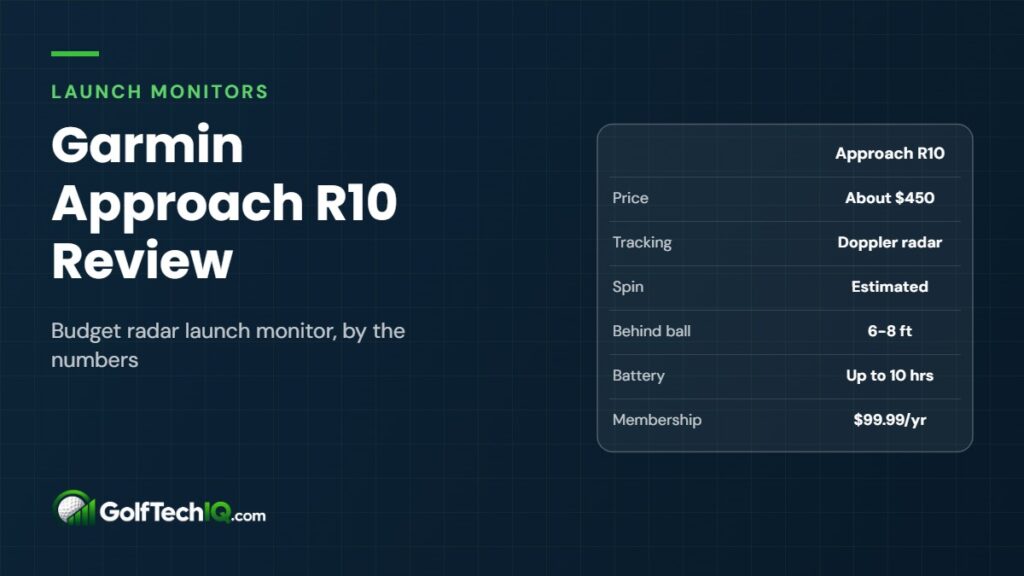
Garmin Approach R10 at a glance
| Spec | Garmin Approach R10 |
|---|---|
| Price | About $450 to $500 (launched at $599.99 in 2021) |
| Tracking | Doppler radar, placed behind the ball |
| Measured directly | Ball speed, club head speed, launch angle, launch direction |
| Calculated / estimated | Spin rate, spin axis, carry, total, apex, club path, face angle, face to path, angle of attack |
| Placement | 6 to 8 ft behind the ball (about 7 ft is ideal) |
| Indoor ball flight | At least 8 ft from ball to net or screen |
| Minimum room (Garmin) | 15 ft long, 8 ft wide, 8 ft high |
| Battery | Up to 10 hours, USB charging |
| Size / weight | 3.5 x 2.8 x 1 in, about 5.2 oz |
| Screen | None (uses your phone or tablet) |
| Subscription | Garmin Golf membership, about $9.99/month or $99.99/year, for Home Tee Hero |
| Third-party sims | GSPro, E6 Connect, Awesome Golf, and others |
Check price on Amazon Check price at The Indoor Golf Shop
How the R10 works: Doppler radar from behind the ball
The R10 is a palm-sized Doppler radar unit. You set it on the ground (or its small tripod) behind the ball, aimed down your target line, and it tracks the club and ball as they move away from it. It pairs over Bluetooth with the Garmin Golf app on your phone or tablet, which is where you see your numbers.
Radar is great at reading speed. That is why club speed and ball speed tend to be the R10’s most trusted numbers. It also reads the launch angle and launch direction of the ball right off the face. Everything else is built from those inputs plus Garmin’s ball flight model.
Outdoors, the radar can follow the ball much longer, so its calculations have more real flight to work with. Indoors, the ball hits a net or screen within a few feet, so the R10 has to predict the rest of the shot from a short window of data.
Measured vs estimated data: what you can trust
This is the most important thing to understand before you buy. The R10 shows 14-plus data points, but only a handful are measured directly. Here is how retailers and Garmin’s own documentation break it down:
| Data type | Metrics | How it’s produced |
|---|---|---|
| Ball | Ball speed, launch angle, launch direction | Measured by radar |
| Club | Club head speed, swing tempo | Measured |
| Spin | Spin rate, spin axis | Estimated (better with RCT balls) |
| Club delivery | Club path, face angle, face to path, angle of attack | Derived from radar data |
| Ball flight | Carry, total, apex, deviation, smash factor | Calculated from the above |
Spin matters because it drives carry distance and curve. When spin is estimated, a shot that really fades a little might show as straight, or a high-spin wedge might carry a few yards different than it would on the range. For speed training, gapping your clubs at a basic level, and simulator fun, the R10 is fine. For dialing in exact spin numbers on a driver fitting, it is not the right tool.
The Titleist RCT ball upgrade
In 2022, Garmin added support for Titleist Pro V1 and Pro V1x RCT balls. These balls carry a special internal layer that radar can read more easily. Garmin claims spin readings can be up to 30 times more accurate and carry distance up to 50% more accurate with RCT balls indoors. If you plan to use the R10 mostly in a garage or spare room, a dozen RCT balls is the cheapest accuracy upgrade you can buy.
Space needed: behind the ball and in front of it
Because the R10 sits behind you, it needs more room front to back than a side-mounted camera unit. Garmin’s manual and spec sheet give these numbers:
- Behind the ball: 6 to 8 ft, with about 7 ft as the sweet spot.
- Ball to net or screen: at least 8 ft indoors. More is better, since the radar gets more flight to read.
- Minimum room: 15 ft long, 8 ft wide and 8 ft high, per Garmin.
Add the two distances together and you need at least 14 to 16 ft of depth just for the radar and ball flight, plus space for the net or screen and some room behind it for the screen to absorb impact. Many retailers suggest 20 ft or more of depth for a comfortable setup. Ceiling height is about your swing, not the radar: if you can swing a driver freely, the R10 does not care. See our guides on how much space a golf simulator needs and ceiling height for a golf simulator, or plug your room into the golf simulator room size calculator.
If your room is short on depth, a radar unit behind the ball may not be your best fit. Our list of launch monitors for small rooms and low ceilings covers options that sit beside the ball instead.
Garmin Golf membership and Home Tee Hero
Out of the box, the free Garmin Golf app gives you a driving range mode with your shot data, session stats and swing video capture. That alone makes the R10 a usable practice tool with no extra cost.
To play virtual rounds, you need a Garmin Golf membership. It runs about $9.99 a month or $99.99 a year, with a 30-day free trial. The membership unlocks Home Tee Hero, Garmin’s own simulator, with 43,000-plus courses, plus other perks for Garmin watch owners like green contour data.
Home Tee Hero got a meaningful upgrade in January 2026. R10 owners now get a separate Home Tee Hero app for iPhone and Android with better course graphics that used to be limited to the pricier R50, a set of enhanced high-detail courses, and a new on-course practice mode that lets you jump to a hole and hit the same shot over and over. You still need a phone running both the Garmin Golf app and the Home Tee Hero app, and an active membership.
Compared with other budget launch monitors, $100 a year is cheap. Rapsodo’s Premium plan for the MLM2PRO runs about $199.99 a year, for example.
Third-party simulator software: GSPro, E6 Connect, Awesome Golf
One big reason the R10 is still a popular “Garmin golf simulator” pick is that it is not locked to Garmin’s software. It works with the main third-party sim platforms:
| Software | Platforms | Approx cost | Notes |
|---|---|---|---|
| Home Tee Hero | iPhone, Android | $99.99/yr (Garmin Golf) | Cheapest way to play courses |
| GSPro | Windows PC only | About $250/yr | Officially supports the R10; huge community course library |
| E6 Connect | iOS, Windows PC | Varies by plan | R10 buyers have received 5 free iOS courses |
| Awesome Golf | iPad, PC | Varies by license | Game-like, family friendly |
Keep in mind that a third-party sim cannot add data the R10 does not produce. GSPro will look more realistic than Home Tee Hero, but the spin it uses is still Garmin’s estimate. Many owners start with Home Tee Hero and move to GSPro once they build out a full bay with a PC and projector. Our golf simulator cost guide shows how those extras add up.
Battery, build and portability
Garmin rates the battery at up to 10 hours, which covers several range sessions between charges. It charges over USB, and you can keep using it while it charges, which is handy for a permanent indoor setup. It is about the size of a deck of cards, weighs around 5 oz, and has an IPX7 water rating, so a sudden shower at the range is not a problem.
There is no built-in screen. Your phone or tablet is the display, and the box includes a phone holder that mounts on the tripod. That keeps the price low, but it means your phone battery and Bluetooth connection are part of the experience.
Price trends: what to pay in 2026
The R10 launched in 2021 at $599.99. Over time the price has come down, and authorized retailers now list it at about $500, with Amazon often showing a list price near $449. Deal trackers have recorded several sales at about $400, most recently in June 2026, and older dips went even lower. Garmin also relaunched the R10 in Japan in May 2026 at a new lower price, a sign that Garmin plans to keep selling it rather than retire it.
Our take: around $400 is a strong deal, $450 is fair, and paying more than $500 for a new unit is hard to justify. Holiday sales and spring golf season are the usual windows for discounts. Check the current price: Garmin Approach R10 on Amazon.
Pros and cons
Pros
- About $400 to $500 for a launch monitor that also runs a full course simulator
- Cheap optional subscription (about $99.99/year) with 43,000-plus courses
- Works with GSPro, E6 Connect and Awesome Golf
- Reliable speed data: club speed and ball speed are measured directly
- Up to 10 hours of battery, tiny and water resistant
- Works indoors and outdoors with no special lighting
Cons
- Spin, curve and club delivery numbers are estimated, not measured
- Needs 6 to 8 ft behind the ball plus at least 8 ft of ball flight indoors
- No built-in screen; depends on your phone or tablet
- Best indoor spin needs pricier Titleist RCT balls
Garmin R10 vs Rapsodo MLM2PRO
The MLM2PRO is the R10’s closest rival. It combines radar with two cameras and can measure spin directly, but only with Callaway RPT balls and only with a Premium membership. It typically sells for about $600 to $700, and Premium costs about $199.99 a year after a 45-day trial. It sits 6.5 to 8.5 ft behind the ball, so space needs are similar to the R10.
| Garmin R10 | Rapsodo MLM2PRO | |
|---|---|---|
| Price | About $450-$500 | About $600-$700 |
| Tech | Radar | Radar + 2 cameras |
| Spin | Estimated | Measured (RPT balls) |
| Subscription | $99.99/yr | $199.99/yr |
| Behind ball | 6-8 ft | 6.5-8.5 ft |
| GSPro / E6 | Yes / Yes | Yes / Yes |
Pick the MLM2PRO if measured spin matters to you and you do not mind the higher yearly cost. Pick the R10 if you want the cheaper long-term package and a more mature sim ecosystem. We break it down further in Garmin R10 vs Rapsodo MLM2PRO.
Garmin R10 vs Shot Scope LM1
The Shot Scope LM1, released in March 2026, costs about $200 with no subscription. It is also a Doppler radar unit placed about 6 ft behind the ball, but it has a built-in 3.5-inch color screen, so you do not need a phone. The trade-off is data: it shows five numbers (club speed, ball speed, smash factor, carry and total distance) with no spin or launch angle, and it is not built for simulator course play. Battery runs up to about 5 hours.
The LM1 is a speed and distance trainer. The R10 is a launch monitor and simulator. If you only want to track swing speed and carry at the range, the LM1 saves you about $250. If you want to play courses at home, the R10 is the clear pick.
What about the Garmin Approach R50?
Garmin’s newer launch monitor, the Approach R50, launched in November 2024 at about $5,000. It is a very different product. Instead of radar behind the ball, it uses three high-speed cameras and sits beside the ball. It measures spin directly, tracks 15 ball and club data points, captures impact video, and has a 10-inch color touchscreen with Home Tee Hero built in, so no phone is needed. It also has an HDMI input for a projector or TV, and a standalone battery rated at about 4 hours.
In short, the R50 competes with premium camera units, not with the R10. Because it sits beside the ball, it can also work in rooms without the extra depth the R10 needs. The R10 remains Garmin’s budget option, and the January 2026 Home Tee Hero update brought some of the R50’s course graphics down to it.
Who should buy the R10, and who should skip it
Buy it if:
- You want your first home golf simulator for well under $1,000 in hardware
- You have a garage or room with at least 15 to 20 ft of depth
- You care most about club speed, ball speed and carry trends
- You want to use the same unit at the range and at home
Skip it if:
- You need measured spin and club data for fitting-level feedback
- Your room is too shallow for 6 to 8 ft behind the ball plus 8 ft of flight
- You only want swing speed and carry and would rather not pay a subscription (look at the LM1)
Verdict
Five years after launch, the Garmin Approach R10 is still the best value in budget launch monitors by the numbers. At about $400 to $500, with a $99.99 yearly subscription and support for GSPro, E6 Connect and Awesome Golf, nothing else gets you into a full course simulator this cheaply. Just go in knowing that spin is estimated, give it the room it needs, and consider Titleist RCT balls for indoor play. If measured spin is a must, step up to the MLM2PRO; if money is no object, the R50 is Garmin’s camera-based answer.
Check price on Amazon Check price at The Indoor Golf Shop
Part of our guide: Launch Monitor Guide
FAQ
Does the Garmin R10 measure spin?
Not directly. The R10 measures ball speed, club speed, launch angle and launch direction, then estimates spin rate and spin axis. Titleist Pro V1 and Pro V1x RCT balls help it read spin much more accurately indoors.
Do you need a subscription for the Garmin R10?
No for basic use. The driving range mode and shot data work in the free Garmin Golf app. A Garmin Golf membership, about $9.99 a month or $99.99 a year, is needed for Home Tee Hero virtual rounds.
How much space does the Garmin R10 need indoors?
Garmin says to place it 6 to 8 ft behind the ball and keep the ball at least 8 ft from the net or screen. Its stated minimum room is 15 ft long, 8 ft wide and 8 ft high, though 20 ft or more of depth is more comfortable.
Can the Garmin R10 be used as a golf simulator?
Yes. With a membership, Garmin’s Home Tee Hero app turns it into a simulator with 43,000-plus courses. It also connects to GSPro (Windows PC), E6 Connect and Awesome Golf for more realistic graphics.
How long does the Garmin R10 battery last?
Up to 10 hours per charge, according to Garmin. It charges over USB and can keep running while plugged in.
Is the Garmin R50 worth it over the R10?
Only if you want measured spin, a built-in screen and a camera unit that sits beside the ball, and can spend about $5,000. For most home golfers on a budget, the R10 does the job for about a tenth of the price.
Sources: Garmin Approach R10 Owner’s Manual, PlayBetter R10 FAQs & Specs, Garmin Newsroom: Home Tee Hero upgrades, Garmin Newsroom: R10 and Titleist RCT balls, Garmin Japan R10 relaunch (PR Times), GSPro, PlayBetter Rapsodo MLM2PRO, Golf Digest: Shot Scope LM1, MyGolfSpy: Garmin Approach R50 first look, Slickdeals R10 price history
Keep reading
 Best Golf Launch Monitors (2026): 10 Picks by Budget
The best golf launch monitors of 2026 compared by price, room space, data and yearly subscription, from the $200 Shot…
 SkyTrak+ Review (2026): Photometric Plus Radar for Home Sims
The discontinued SkyTrak+ pairs a photometric camera with dual Doppler radar and sits beside the ball, making it a strong…
 Bushnell Launch Pro Review (2026): GC3 Accuracy, Subscription Costs
The Bushnell Launch Pro packs Foresight GC3 camera hardware for less than half the price. Here is what it measures,…